Friday, August 31, 2012
Yemen will Host an International Workshop on Islamic Microfinance
Saturday, August 11, 2012
The Pioneer Islamic Microfinance Magazine will be Launched in September, 2012
Saturday, July 21, 2012
AlHuda CIBE introduces Free Advisory services during the Holy Month of Ramadan
AlHuda Centre of Islamic Banking & Economics (CIBE ) is a well established name in the Islamic Banking and Finance working for Advisory, Education, Islamic Financial products development & Awareness.
Muslims around the world are welcoming the arrival of the holiest month of the Islamic year. In this Holy month, Alhuda Centre of Islamic Banking and Finance offers the following complementary services to masses to reap the full benefit of this blessed month:
- Free Shariah Advice and Consultancy
Alhuda has established an expert panel of Shariah Scholars & Finance professional for giving free advisory services to businessmen/General Public for removing the day to day problems and issues related to:
- Zakah & Usher Calculation
- Religious issues related to business, financial, banking and Halal Food etc.
- Other religious matters & Free literature service about Islamic Finance
The imminent Shariah experts would receive your live calls from 9:00 am to 12:00 (noon) till end of Ramadan. So do not hesitate to contact and get your problems resolved.
AlHuda CIBE also offers 25% discount on its distance learning programs on Islamic banking and finance during the Holy month with the theme to spread the blessings of Ramadan by bringing individuals in Shariah compliant and true profession to earn their livelihood.
Get Registered and Reap the Benefits of the Holy Month! For more information please visit: www.alhudacibe.com/dlp
South Africa Names Six Companies to Advise on Sukuk Sale
Nova Capital Partners LLC, Liquidity Management House for Investment Co., and Regiments Capital (Pty) Ltd. were also appointed, Tshepiso Moahloli, a senior analyst in the Pretoria- based Treasury, said by phone today.
The Islamic bonds, or sukuk, may form part of the Treasury’s plan to raise $3 billion in international markets over the next three years, she said. South Africa, where less than 2 percent of the 49.1 million people are Muslim, is looking to tap the Islamic finance industry’s $1 trillion in assets.
“We’re engaging with the banks now; the amount, currency and timing will depend on the outcome of our discussions,” Moahloli said. “From what we have observed, issuance tends to be from $500 million to about $700 million and movement around the five-year sukuk area looks like it’s the most favored area.”
The structuring and issuance of the sukuk may be used as a benchmark for state-owned companies that also plan to issue Islamic bonds, Moahloli said.
Public Finance Law
Sukuk are usually backed by assets sold to a special- purpose company by the issuer, which then rents them back in lieu of paying interest. The debut Islamic bond issue was delayed after the government decided to review public finance law, which doesn’t provide for the government to issue asset- based securities, Thuto Shomang, head of asset and liability management at the Treasury, said on May 17.Moody’s Investors Service rates South Africa A3, the second-highest investment grade on the continent, according to data compiled by Bloomberg.
The country should not limit itself to an international sukuk, Jay Henning, an executive at Cape Town-based money manager Oasis Group Holdings, said by phone.
“While we agree with an international issue, there is definitely demand for a South African issue as well,” Henning said. “We have capacity for it and I’m sure other Sharia- compliant asset managers do as well.”
To contact the reporter on this story: Stephen Gunnion in Johannesburg at sgunnion@bloomberg.net
Wednesday, July 11, 2012
Bank Sohar, Path Solutions ink pact for Islamic banking system
Bank Sohar, Oman's dynamic banking institution and Path Solutions, a global provider of software solutions to the Islamic financial services industry yesterday announced that they have inked pact at a signing ceremony in Muscat, Oman.
Bank Sohar selected Path Solutions after evaluating several software solutions providers. Bank Sohar has become the fourth bank in the Sultanate of Oman to adopt Path Solutions' iMAL system reaffirming Path Solutions' position as a leading banking and financial software powerhouse in the region.
Speaking on the occasion, Dr. Mohamed Abdulaziz Kalmoor, CEO of Bank Sohar said that innovation is imperative in this era of globalization and added, "We were impressed with Path Solutions' willingness to meet our needs in providing end-to-end AAOIFI-certified Islamic banking solution. iMAL is a flexible and scalable banking platform that will drive new business models around Sharia principles, which will in turn increase the volume of our business, thus helping Bank Sohar achieve and maintain competitive edge."
Recently Bank Sohar partnered with Dar al Sharia, a reputed Sharia consultancy firm, to make sure that there is no compromise in the development of products, processes and systems and to also make sure that the staff is trained by experts from the region.
Bank Sohar has identified three areas of utmost importance for ensuring that its Islamic window is a solution that respects the basic tenets of Islam, the sensibilities of Omanis and is within the guidelines of the Central Bank of Oman. These include proper training and development of staff to deliver Islamic products, a proper and certified Islamic banking system and products that have a proper grounding in Sharia and are backed up by relevant Fatwa from respected scholars.
Mujahid Said al Zadjali, AGM and Head of IT, Bank Sohar said, "The bank leverages IT to make the customer's experience more convenient, effective and efficient through services such as 'Anytime, Anywhere Banking' through a range of Delivery Channels, such as Branches, ATMs, e-Banking and SMS, and across Payment and Settlement systems and it is our endevour to implement Islamic banking solution smoothly within a given time frame."
Mohammed Kateeb, Group Chairman & CEO, Path Solutions commented, "We consider this opportunity to work with Bank Sohar an endorsement of Path Solutions' leadership positioning in the Islamic banking sector. Bank Sohar will seek to service a market niche in Oman that has only been lightly tapped by local financial institutions, becoming a major participant in the market for Sharia-compliant Islamic securities, treasury and investment products. We look forward to working with Bank Sohar for the successful completion of this project."
Path Solutions' customer base spans across 28 countries. The company has a strong presence in the Middle East, Africa, Asia Pacific and England. Path Solutions' other customers in the Sultanate of Oman include Bank Nizwa, Bank Dhofar and Ahli Bank Oman.
|
|
|
It has been reported that the next phase of
growth of the Islamic capital market would be characterised by greater
internationalisation, which would see more product issuers and service
providers expanding beyond their home market.
The Securities Commission's executive director of
Islamic capital market, Zainal Izlan Zainal Abidin said that more
investors would seek products or instruments with international
exposure.
Speaking at the 7th Islamic Markets Programme, he
said there would also be greater diversity in terms of currencies used
in issuing Shariah-compliant instruments.
Izlan said the Islamic finance industry was at a
crucial stage where it needed to redefine and establish the enabling
environment that will spur its next phase of growth. Islamic finance, he
said, had developed into an industry with global appeal, marked by a
15% average annual growth rate over the past decade, to reach US$1.3
trillion to date. As for Malaysia's Islamic capital market, the Capital
Market Masterplan 2 was expected to grow at an average rate of 10.6% per
annum, over the 10-year period to 2020.
Izlan said Islamic finance had developed not only in
traditional Muslim markets like Malaysia and the Middle East, but also
in conventional markets and financial centres such as the UK, with a
growing number of jurisdictions across the globe at various stages of
developing their capabilities in Islamic finance. Themed "Building the
Environment for the Growth of Islamic Finance", the IMP attracted 41
local and international participants including Islamic finance
practitioners, members of academia and regulators.
|
| Central Asian and African Countries are the New Destinations of Islamic Finance: Zubair Mughal |
| Islamic Banking and Financial Industry Lacks Better Human Resources |
| 29/06/2012 |
![]() |
| Muhammad Zubair Mughal, CEO, AlHuda CIBE is speaking at The First International Forum on Islamic Banks and Financial Institutions, at Jordan |
| The First International Forum of Islamic Banks and Financial Institutions held under the patronage
of His Excellency, Dr. Fayez al-Tarawneh– Prime Minister of Jordan has come to end today
in Amman; the Capital city of Jordan. The Forum was jointly organized by General Council of
Islamic Banks and Financial Institutions - Bahrain and Strategy - Jordan. In this forum, different
topics like Emerging trends of Islamic Banking in Arab Countries, Legal and Taxation matters of
Islamic banking, Role of International Institutes in Islamic Banking and finance and Importance
of Education and awareness of Takaful and Islamic banking etc. were discussed. A good number
of Experts & Professionals from different countries like Pakistan, Malaysia, Palestine, Indonesia,
Bahrain, UAE, Qatar, Saudi Arabia etc. participated in this mega forum.
While addressing to the concluding session, Chief Executive Officer of AlHuda Centre of Islamic Banking and Economics, Mr. Muhammad Zubair Mughal said that presently, Islamic banking is growing at a very rapid pace and the Central Asian Countries (Kazakhstan, Afghanistan, Tajikistan, Uzbekistan, Kyrgyzstan, Azerbaijan) and African Countries (Nigeria, Tanzania, Kenya, Ghana, Tunisia, Senegal etc) are its new destinations of Islamic Banking and Finance where the rapid increase in the demand of Islamic banking is being observed and majority of these countries are providing shield to Islamic banking and finance industry by bringing alterations in Laws through parliaments. While presenting the review of present Islamic Finance Industry, he said that the market of Islamic finance has reached to $1.3 Trillion, in which the share of Islamic banking is 77% ($1 Trillion), share of Sukuk is 14% ($180 Billion), share of Islamic Funds is 5% ($64 Billion) and share of takaful is 1% ($12 Billion) whereas the share of other Islamic financial products like Islamic Leasing, Mudarabah Companies, Islamic Microfinance and Islamic REITs is 3% ($44 Billion). He said that in comparison with the rate of growth of Islamic Banking; the Islamic banking graduates are not being produced accordingly due to which there is a lack of supply of Man Power than the demand of Islamic Banking and finance which should be resolved immediately. He said that not only new Experts of Islamic banking and finance should be produced to be utilized in the emerging market of Islamic banking and finance but the non-qualified personnel in Islamic banking and staff of conventional banks should be changed into Islamic Financial experts so that Islamic banking could be run by qualified Islamic bankers. He further said that Islamic banking and Finance should not be only for well-off, Business personnel or middle class but its benefits should also be disseminated to poor through Islamic Microfinance so that they could get rid of poverty and live their lives respectfully through proper employment. |
| 50 Thousand Islamic Financial Professional Needed Globally |
| HR Crisis May arise if Demand and Supply Remain Unbalanced |
![]() |
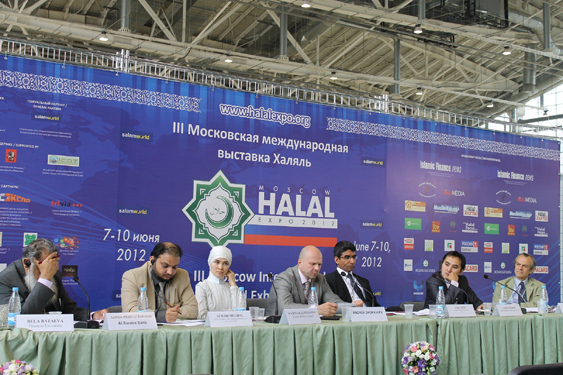
| Zubair Mughal, CEO, AlHuda Centre of Islamic Banking and Economics speaking about Islamic Banking and Finance at Moscow Halal Expo at All Russian Exhibition Centre - Moscow, Russia |
| (Moscow) - In accordance with the growing industry of Islamic Banking and Finance, the whole
world needs 50,000 Islamic Finance Experts right away so that the emerging market of Islamic
Banking and Finance may be easily promoted. These thoughts were expressed by Mr. Muhammad
Zubair Mughal, Chief Executive Officer – AlHuda Centre of Islamic Banking and Finance, during his
speech on the topic of “Importance of Islamic Finance Education” in “Moscow Halal Expo” held in
All Russian Exhibition Centre - Moscow; the capital city of Russia. He said that due to the recent
International Financial Crises in conventional banking and finance, the world is moving rapidly
towards alternative system of banking and finance and undoubtedly, the Islamic banking and
finance system is the first and the foremost choice in this regard because the during financial crisis
had very fewer impact on Islamic finance industry which is the assurance of its future success.
He said that education of Islamic banking and finance is immediately needed internationally. At this time, 38 universities in the world are producing approximately 5000 graduates of Islamic banking and finance per annum, whereas relatively its demand is 10 times more around the globe. If this demand and supply would not be balanced in short time then Islamic banking and finance industry may face many obstacles in its growth and promotion. In the recent era, conventional bankers are being provided with trainings having some of the essentials of Islamic banking and finance in order to adjust them in Islamic financial industry which is a wrong approach and is creating many reservations in financial industry. He further said that in order to establish Islamic banking and finance system on strong foundations, it is needed to produce graduates with complete knowledge of Islamic banking and finance having full command on Shari’ah, Fiqah and Islamic financial products. In this regard, AlHuda Centre of Islamic Banking and Economics has introduced its MBA and Post Graduate Diploma on Islamic banking and finance based on the mode of Distance learning so that the people of countries which currently do not have any facilities of Islamic banking and finance could get advantage of this facility from their office or home and strengthen the rapidly emerging market of Islamic banking. He said that 4 pronged approaches should be adopted in order to educate masses in the field of Islamic banking and finance. 1) Graduation, Masters and Post Graduate Diploma programs on Islamic banking and finance should be arranged at University or College level in order to produce incumbents who could fulfill the responsibilities in Islamic financial institutions at managerial level in an excellent manner. 2) At post graduate level, one year diploma and six months certificate courses on different topics like Islamic banking, Sukuk (Islamic Bond), Takaful (Islamic Insurance), Islamic Fund and Islamic Microfinance should be arranged so that the experts in these fields could be produced. 3) Online programs on Islamic banking and finance should be promoted so that the awareness of Islamic banking and finance may be promoted worldwide as only 20 countries are providing education in this field. 4) Workshops, trainings and publications in the field of Islamic banking and finance should be promoted in order to encourage awareness among masses regarding this. |
Friday, February 24, 2012
Pakistan to host an International Conference on Islamic Funds
23 February 2012 (Lahore) The Financial world is banking upon the Islamic Finance and Shariah Compliant Investment Funds, in the backdrop of the current global financial crisis, which in turn is bringing a boost to the Islamic Funds and Sukuks. Considering the healthy global growth in this sector, an International Conference is being organized on April 23, 2012 in Karachi in order to strengthen the Islamic finance sector in Pakistan. Research papers will be presented and productive discussions will be undertaken to highlight the role of Pakistan in the global Islamic finance market. Islamic finance is making healthy growth in Pakistan which now stands over 1000 Islamic banking branches from 05 Islamic Banks and 13 Conventional Banks with Islamic finance operations. In addition, we have good support from 05 Takaful Companies, Mudarabah Companies, 20 Islamic Microfinance Institutions, over 30 Sukuk issues and 15 fund managers have launched their Islamic Funds, which have made prominent role of Pakistan in the global Islamic finance canvas.
The organizer of this International Conference and Chief Executive Officer, AlHUda-Centre of Islamic Banking and Economics, Mr Zubair Mughal while declaring the objectives behind this conference, highlighted the valuable contribution by Pakistanis in research, shariah and skilled professionals bringing strong alternative in a difficult financial situation faced by the world.
Mr Zubair added that Islamic funds are rapidly gaining popularity in US$1.3 Trillion worth of global Islamic finance market gaining 6.1% share from over 650 funds spread all over the world, of which the highest 230 is in Saudi Arabia while Malaysia has 172, Cayman Island 59, Bahrain 46, Luxemburg 29, Dubai 16, Singapore 11 are the prominent players in the world.
Zubair Mughl further informed the media that a healthy number of participants from different countries will be attending in this conference which will be followed by a Two Days Specialized Workshop on the Shariah and Regulatory Framework for Islamic Funds on 24th and 25th of April, 2012 to be conducted in Karachi, Pakistan.
Thursday, February 23, 2012
Islamic Finance and Funds Industry gaining brisk popularity
| International Conference on Islamic Funds and Investments opened in Karachi; A large number of investors participated in the Conference |
| February 23, 2012 |
| (Karachi)
An International Conference on Islamic Funds and Investment opened
today in a local hotel in Karachi, participated by a large number of
investors from UAE, USA, UK, Canada, Malaysia and Qatar. The topics
covered on first day of the Conference were, Investment opportunities
for Islamic Funds, Shariah status and Mechanism of Islamic Investments
and Funds with global trends, Standardization and Brokerage and exchange
rules and the Islamic Exchange Indices. The next two days have been
allocated for training workshops on the allied topics on Islamic
Investments, Marketing and Shariah guidelines. A large number of well known Shariah Scholars and Islamic finance professionals including: Mr Irfan Siddiqui, CEO, Meezan Bank Limited. Pakistan; Majid Siddique Dawood, CEO, Yassar Ltd. UK; Mr. Asif Arif Commissioner, Securities and Exchange Commission of Pakistan; Mr. Saleem Ullah, Director, Islamic Banking State Bank of Pakistan; Omar Farooq Kalair, CEO, Um Financial Group, Canada; Shamshad Nabi, CEO, MUFAP; Prof Dr. Aurangzeb, HOD, Business Administration Department, Dadabhoy Institute Of Higher Education, Karachi; Mohammad Shoaib, CFA, Chief Executive, Al Meezan Investment Management Limited; Nadeem Naqvi, MD, Karachi Stock Exchange Limited, Pakistan; Kavilash Chawla, MD, Nur Global Strategies, Chicago, U.S.A; Ms. Tara Uzra Dawood, Chief Executive Officer, Dawood Capital Management Ltd, Pakistan; Dr. Zubair Usmani Shariah Advisor MCB Bank Limited, Pakistan; Syed Tariq Ali, Executive Director, Pathway Global LLC, UAE; Mufti Muhammad Najeeb Khan, Shariah Advisor, Habib Metropolitan Bank Limited, Pakistan; Qazi Abdul Samad, Shariah Advisor, The Bank of Khyber, Pakistan; Azeem Iqbal Pirani Regional Manager FWU Group and Muhammad Asad, Chief Investment Officer, Al-Meezan Investments Ltd. Islamic finance is making healthy growth in Pakistan which now stands over 1000 Islamic banking branches from 05 Islamic Banks and 13 Conventional Banks with Islamic finance operations. In addition, we have good support from 05 Takaful Companies, Mudarabah Companies, 20 Islamic Microfinance Institutions, over 29 Sukuk issues and 15 Asset Management Companies have launched their Islamic Funds, which have made prominent role of Pakistan in the global Islamic finance canvas. The organizer of this International Conference and CEO, AlHUda-CIBE, Mr Zubair Mughal while declaring the objectives behind this conference, highlighted the valuable contribution by Pakistanis in research, shariah and skilled professionals bringing strong alternative in a difficult financial situation faced by the world. Mr Zubair added that Islamic funds are rapidly gaining popularity in US$1.3 Trillion worth of global Islamic finance market gaining 6.1% share from over 650 funds spread all over the world, of which the highest 230 is in Saudi Arabia while Malaysia has 172, Cayman Island 59, Bahrain 46, Luxemburg 29, Dubai 16, Singapore 11 are the prominent players in the world. Mr Zubair Added that Islamic Funds industry is growing with other aspects of Islamic Finance including Mudarabah and Takaful businesses. Some of these funds are the leading funds in Asian markets as well, which is a matter of honor for Pakistan and can be taken as the source of further development in this sector. He further added that from the bright prospects for Islamic Funds other allied sectors like brokerage houses; stock market indices etc will also gain momentum. The hosts and organizers of the Conference AlHuda Center of Islamic Banking and Economics are organizing it with the technical support of Meezan Bank and UBL Asset Management limited and the support of other including Al-Meezan Investment Management Ltd, Dawood Capital Management Ltd, FWU, Burj Bank Ltd, Dadabhoy Institute of Higher Education, Diyanah Financial Services, Khyber Bank Ltd, ABL Asset Management Ltd, Habib Metropolitan Bank and Babib Mudarabah to make the Conference successful. |
Tuesday, February 21, 2012
International Conference on Islamic Fund and Investment

Greetings from AlHuda Centre of Islamic Banking and Economics – Pakistan
AlHuda Center of Islamic Banking and Economics is a recognized name in Islamic banking and finance Market for Trainings, Research and Advisory over the last six years. We are dedicated to serve the community as a unique institution providing Trainings, Education and Consultancy in the field of Islamic Banking & Finance not only in Pakistan but all over the world.
AlHuda Centre of Islamic Banking and Economics is pleased to invite you on the “International Conference on Islamic Fund and Investment” scheduled to be held on 23 April, 2012 at Avari Tower, Karachi - Pakistan.
The Islamic funds market is one of the fastest growing sectors of financial industry not in Muslim but also in Non Muslim Countries. The key goal to conduct this conference is to highlight the value and importance of Islamic funds, Islamic means of investments and alternatives and to identify the characteristics that distinguish Islamic funds from conventional investments.
At this conference, you will enjoy meeting and setting connections with the key players of Fund & Investment Management Industry. You are requested to “Support & Participate” in this international conference. Your timely confirmation will facilitate us to finalize the event details and schedules. For any further details about conference, please visit: www.alhudacibe.com/Islamicfunds2012
Wednesday, February 1, 2012
Pakistan is emerging as a global leader of Islamic Microfinance: Zubair Mughal
01-02-2012
(Istanbul) Two days International summit on Islamic Microfinance is started in Istanbul. The basic purpose behind this summit is to promote Islamic Microfinance and to elucidate the strategy to remove obstacles from its way to progress. Microfinance experts from different continents like Africa, Asia, Europe and America etc. are participating in this Int’l summit. While speaking to the opening session of the Summit, Muhammad Zubair Mughal, Chief Executive Officer, AlHuda Centre of Islamic Banking and Economics said that Pakistan has been acknowledged as a leader of Islamic Microfinance Industry and right now in Pakistan; more than 20 institutions are providing microfinance services. While highlighting the importance of Islamic microfinance, he said that around the world, conventional Microfinance has badly failed and its examples can be clearly seen in India and Latin America. He further added that due to the failure of conventional financial system, many countries in the world are adapting Islamic microfinance system for poverty alleviation through which not only poverty will be eradicated but also a sustained economy shall come into being in these countries.
While addressing to the International Summit, he further added that one reason behind expansion of Poverty is interest base mechanism in Muslim countries, People do not use Financial and Banking system due to interest as it is strictly prohibited in Islam hence forced to live in poverty whereas through Islamic Microfinance by using the financial products based on Shari’ah principles, we can get the people out from poverty. He further highlighted the need assessment of Islamic microfinance in Muslim Countries by saying that 44% of conventional Microfinance clients live in Muslim Countries and United Nations has added half of the countries of Islamic Development Bank in the list of least developed countries which shows that Islamic Microfinance can be used to eradicate poverty from Muslim-Majority Counties. While identifying the Muslim population and poverty in different regions of the world, he said that 85.5% in East Asia, 34% in South Asia, 58% in West Africa, 58% in Caucasus and 97.3% in MENA are Muslims and collectively, in 2.4 Billion population of these regions, Muslims are of 48.3% which clearly shows the need of Islamic Microfinance for poverty alleviation in these countries. He further added that not only Muslims but Non-Muslims can also get benefits from Islamic Microfinance because Islamic Microfinance is not a religion but a system which is equally useful for Muslims and Non Muslims as well and the clear example of this fact is that Non-Muslims consider it very attractive.
He said that Islamic Microfinance is essential to achieve Millennium Development Goals( MDGs), proposed by United Nations for alleviating poverty and social uplifting. He further added that if development of Islamic Microfinance starts right from today, these goals can easily be achieved till 2015. He said that Islamic Microfinance sector is facing difficulties due to apathy of Donors and to fulfill this deficiency, Sukuk (Islamic Bonds) can be issued. He further said that more financial products can be introduced by enhancing research in the field of Islamic microfinance and there are many opportunities for development in this field. AlHuda Centre of Islamic Banking and Economics has established a specific Microfinance help desk so that trainings, research and technical consultation could be provided to Microfinance Institutions worldwide.
In this Summit, the role of Pakistan in the development of Islamic Microfinance has very much appreciated and Pakistan is considered to be as global leader of Islamic Microfinance Industry. This conference will continue for 2 days in Istanbul.
Thursday, October 6, 2011
Kazakhstan is the central hub of Islamic finance for CIS countries

Press Release
Kazakhstan is the central hub of Islamic finance for CIS countries: Zubair Mughal
International Islamic financial Institutions are ready for doing investment in Kazakhstan
(Lahore/Kazakhstan, 24th September, 11) They are many chances of investment in Kazakhstan regarding International Islamic Banking and financial institutions are in looking on different options for investments in Kazakhstan because the world sees the Kazakhstan a central hub for Islamic banking and finance for CIS countries. These are the views of Muhammad Zubair Mughal the Chief executive officer of Al-HUDA centre of Islamic banking and economics, which he expressed in his speech in the International finance forum that is held in the Astana the capital of Kazakhstan in this week. In which the Finance minister Mr. Zhamishev Bolat of republic of Kazakhstan, the vice member of the chancellor of Prime Minister Mr. Tolevkhanov Dauren, the member of the area of department of strategic progress and research of President Administration Mr. Sadvawasov Darmen, the senator of the Kazakhstan Parliament Mr. Yensegenov Sarsenbag, the chairman of the committee of national bank of republic of Kazakhstan Mr. Nurpeissov Darkhan, the executive director of Zakat fund Mr. Alpysbay Edige and include International experts. The theme of the conference was to make fruitful plan and procedures for the development and expansion of Islamic finance in Kazakhstan.
By addressing to the forum, Mr. Muhammad Zubair Mughal presented the origin and starting of Islamic banking and finance in Pakistan in the form of case study that how Pakistan make fast success in Islamic banking in a short period of time. They said that Kazakhstan while doing Islamic banking and Sukuk should also utilize and use the Takaful, Islamic fund, Islamic microfinance and Islamic Reits side by side and for the development of infrastructure the government and Kazakhstan should issue Sukuk in International market so that the Kazakhstan is recognized as the Islamic Financial state in the international market.
He said Kazakhstan is one of the ninth biggest countries of world which holds the 70% population of Muslims from the 16.5 million populations, that is the sign of huge market of Islamic banking and finance. Due to which by making the Kazakhstan the model of Islamic Finance for the rest of CIS countries so that the implementation of Islamic banks and finance their can easily be done. Especially in Central Asian countries because there the population of Muslims is very much huge like Kazakhstan 70%, Uzbekistan 97%, Azerbaijan 99%, Turkmenistan 94%, Kyrgyzstan 86%, Tajikistan 84% is Muslim population. That is the clear sign of the progress and demand of Islamic banking there.
Monday, September 26, 2011

Press Release
Kazakhstan is the central hub of Islamic finance for CIS countries: Zubair Mughal
International Islamic financial Institutions are ready for doing investment in Kazakhstan
(Lahore/Kazakhstan, 24th September, 11) They are many chances of investment in Kazakhstan regarding International Islamic Banking and financial institutions are in looking on different options for investments in Kazakhstan because the world sees the Kazakhstan a central hub for Islamic banking and finance for CIS countries. These are the views of Muhammad Zubair Mughal the Chief executive officer of Al-HUDA centre of Islamic banking and economics, which he expressed in his speech in the International finance forum that is held in the Astana the capital of Kazakhstan in this week. In which the Finance minister Mr. Zhamishev Bolat of republic of Kazakhstan, the vice member of the chancellor of Prime Minister Mr. Tolevkhanov Dauren, the member of the area of department of strategic progress and research of President Administration Mr. Sadvawasov Darmen, the senator of the Kazakhstan Parliament Mr. Yensegenov Sarsenbag, the chairman of the committee of national bank of republic of Kazakhstan Mr. Nurpeissov Darkhan, the executive director of Zakat fund Mr. Alpysbay Edige and include International experts. The theme of the conference was to make fruitful plan and procedures for the development and expansion of Islamic finance in Kazakhstan.
By addressing to the forum, Mr. Muhammad Zubair Mughal presented the origin and starting of Islamic banking and finance in Pakistan in the form of case study that how Pakistan make fast success in Islamic banking in a short period of time. They said that Kazakhstan while doing Islamic banking and Sukuk should also utilize and use the Takaful, Islamic fund, Islamic microfinance and Islamic Reits side by side and for the development of infrastructure the government and Kazakhstan should issue Sukuk in International market so that the Kazakhstan is recognized as the Islamic Financial state in the international market.
He said Kazakhstan is one of the ninth biggest countries of world which holds the 70% population of Muslims from the 16.5 million populations, that is the sign of huge market of Islamic banking and finance. Due to which by making the Kazakhstan the model of Islamic Finance for the rest of CIS countries so that the implementation of Islamic banks and finance their can easily be done. Especially in Central Asian countries because there the population of Muslims is very much huge like Kazakhstan 70%, Uzbekistan 97%, Azerbaijan 99%, Turkmenistan 94%, Kyrgyzstan 86%, Tajikistan 84% is Muslim population. That is the clear sign of the progress and demand of Islamic banking there.
Monday, July 25, 2011
Islamic Microfinance Network ( IMFN ) now unlock for membership worldwide

July 25, 2011
Islamic Microfinance sector is currently progress aggressively by addressing of deficiencies and challenges faced by the traditional Microfinance industry, right now near about 300 Islamic Microfinance Institutions are operating around the globe effectively, due to tremendous performance of Islamic Microfinance Institutions, now conventional Microfinance Institutions are opting Islamic system for poverty alleviation at large.
For addressing all the challenges and opportunities Islamic Microfinance, Islamic Microfinance Islamic Microfinance Network (IMFN) has launched in 2010 with the aim to provide a unique and common platform for National and international Islamic microfinance institutions (MFIs). The activities of IMFN includes coordinate the efforts of its members in jointly addressing poverty alleviation, establishing best practices in Islamic microfinance, developing guidelines and the implementation that comply with Shariah law.
Now the membership is being opened for nationally and internationally organization who are serving in the sector of Islamic Microfinance. The membership is available who are practicing Islamic Microfinance in their operations as Permanent members while other conventional Microfinance Institutions are also welcome as observers members, so that they enable to learn about Islamic Microfinance System. It is not only for the institutions while the academician and Advisor also becomes the member of this network.
Zubair Mughal – Chief Executive Officer , Islamic Microfinance Network ( IMFN) said that it is common responsibility of the industry stakeholders to address the things at one platform for brush up and standardization with the objective toward poverty alleviation, he also said that Almost 17,000 million people live below the poverty line in the world of which 44% live in the Muslim majority countries which become the prime reason behind Islamic Microfinance. At the moment 300 Islamic Microfinance Institutions in 32 countries including: Indonesia, Kenya, Afghanistan, Bangladesh, Sri Lanka, Yemen, Egypt, Sudan, Tanzania, Mauritius, South Africa, Malaysia and Pakistan are working on Poverty alleviation. Due to its more productive role, Islamic Microfinance is gaining popularity in those countries where Muslims are in minorities.
Friday, July 15, 2011
Islamic Microfinance can work with all the Microfinance Models of the world: Zubair Mughal

(July 14, 2011)
An International Seminar on Financial Inclusion for Central Asia, the Caucasus, and South Asia organized by Asian Development Bank Institute-Japan, APEC Business Advisory Council -China, & Asia-Pacific Finance and Development Center from 12th – 14th July, 11, concluded days today in Urumqi, Peoples Republic of China. Delegate from China, Japan, Pakistan, Bangladesh, India, Malaysia, Singapore, Kazakhstan, Uzbekistan, Tajikistan, Georgia, New Zeeland, Romania, Kyrgyz, UK and Afghanistan are participating in this Seminar, wherein Current State of Financial Inclusion Developing in Asia, Rural Finance in PR China, Key Regulatory Issues in Promoting Financial Inclusion, Evolution of Microfinance Institutions towards Financial Self-Sustainability through Innovation, Service Diversification and Islamic Microfinance were discussed in details.
The third day was allocated to Islamic Microfinance and Zubair Mughal – Chief Executive Officer, AlHuda Centre of Islamic Banking and Economics Pakistan gave the Key Note speech on Islamic Microfinance, said that Islam has given the best system for poverty alleviation and both Muslims and non-Muslims can benefit from it. He emphasized that the people from Central Asia, the Caucasus, and South Asia can equally get benefit from Islamic principles of Microfinance. He said the out of the total population of 1.7 billion about 562 million are Muslims in these regions, which becomes important for financial inclusion through this system. Islamic Microfinance is compatible to work with any model of Microfinance and it has the alternative to all the products of Conventional system.
Mr. Zubair Mughal further said that in the wake of the current financial crisis all around the globe, the Islamic Microfinance has gained even more importance due to its transparency and sustainability. He also discussed the poverty issues of Central Asia, the Caucasus, and South Asia separately so that Islamic Microfinance becomes an effective tool for poverty alleviation in these areas. Mr. Zubair Mughal offered his services from AlHuda-Centre of Islamic Banking and Economics who have also set up a Help Desk for Advisory, Trainings and Capacity Building for Microfinance Institutions. We provide complete solutions in Islamic Microfinance for poverty alleviation are practiced effectively.
Friday, June 17, 2011
Islamic Microfinance can eliminate the Poverty from the world

AlHuda Centre of Islamic Banking and Economics (AlHuda-CIBE) jointly with Akhuwat organizing an International Conference on Islamic Microfinance on June 13, 2011 at Faisal Masque Auditorium in Islamabad.
The objective of this conference is to share the experiences and research of the seasoned scholars and practitioners of Islamic Microfinance from all over the world for ensuring poverty alleviation from the world. A variety of experiences and models in Islamic Microfinance, Shariah Principles, QArz-e-hasan, Waqf, Micro-Takaful and the use of Technology in Islamic Microfinance will be discussed and shared at the Conference.
One of the important points is to share the Qarz-e-hasan model of Akhuwat which has so far achieved the milestone of Rs. One Billion (Rs.1,000,000,000/-) lending to over 90,000 poor beneficiaries. Almost 17,000 million people live below the poverty line in the world of which 44% live in the Muslim majority countries which become the prime reason behind Islamic Microfinance. In the recent past, the international donor agencies like: USAID, CGAP, World Bank, IFC, Frankfurt Finance School etc have conducted surveys and research which became convincing that Islamic Microfinance in the genuine need in these Muslim majority countries. At the moment 300 Islamic Microfinance Institutions in 32 countries including: Indonesia, Kenya, Afghanistan, Bangladesh, Sri Lanka, Yemen, Egypt, Sudan, Tanzania, Mauritius, South Africa, Malaysia and Pakistan are working on Poverty alleviation. Due to its more productive role, Islamic Microfinance is gaining popularity in those countries where Muslims are in minorities. AlHuda-CIBE has take initiative to setup an Islamic Microfinance Network in coordination with many Islamic Microfinance institutions to bring them together at one platform.
The Organizer of the Conference Mr Zubair Mughal (CEO, AlHUda-CIBE), while declaring the objectives and targets, said “Pakistan is gaining a unique position in Islamic Microfinance, and playing a leading role in this sector, and so hosting of this conference on Islamic Microfinance will further strengthen this idea” Mr. Zubair further explained that this conference will make Islamic Microfinance globally popular and and it will work as the genuine ray of hope for the 40% Pakistanis living below the poverty line.
Other national and International institutions participating in this conference are Islamic Relief Pakistan (IRP), ASASA, CWCD, Muslim Aid, Helping Hand, Khwendo Kor, Scottish Government, Nymet Islamic Microfinance, Awqaf-South Africa, Albaraka-MPCS. Pakistan Microfinance Network (PMN) and Islamic Microfinance Network also supporting this conference.
A new chance in Egypt for Islamic finance

DUBAI: Covered head-to-toe in a black abaya embroidered with red and yellow flowers, Amal Abbas waits for her turn to place a deposit at Cairo’s Al Baraka Egypt Bank, one of Egypt’s two fully-fledged Islamic banks.
Although Egypt is considered the birthplace of Islamic finance, which adheres to Islamic principles banning interest and speculative trading, its growth has lagged due to past corruption scandals, while the previous government sought to enforce a more secular financial system.
But after the Egyptian revolution toppled Hosni Mubarak and his government, Muslims like Abbas are embracing Islamic banking, raising the prospect that Egypt could become another thriving centre of Islamic finance.
“I prefer Islamic finance, it keeps me far from usury and I feel my money is blessed,” said the 50 year-old research centre manager at the Mohandessin branch of Al Baraka Egypt Bank.
“My husband has been dealing with mainstream banks for more than 30 years and all his projects failed because they were funded by unblessed money.”
According to a 2009 report by consulting firm McKinsey, Islamic banking only accounts for three to four per cent of Egypt’s $193 billion banking industry. That compares with 46 per cent in the United Arab Emirates.
“In a post-Mubarak era, the urgency of rebuilding and changing things will clash with the absence of resources and lack of money,” said Ibrahim Warde, adjunct professor at The Fletcher School of Diplomacy at Tufts University.
That will likely present an opportunity for Islamic finance houses in the Gulf region, which now serves as the industry’s global hub.
“Egypt is going to look towards the Gulf for money and it’s going to have to offer Islamic options to maximise investments.”
Cairo-based National Bank for Development, which is converting into a full-fledged Islamic bank, is already 49 per cent-owned by Abu Dhabi Islamic Bank. Al Baraka Egypt is in fact a unit of Bahrain’s Al Baraka Bank.
There’s also keen interest in Egypt for Islamic insurance, or takaful, which makes up five per cent of Egypt’s $1.45 billion insurance market but is expected to grow dramatically, according to a March report by Islamic consultancy BMB Islamic.
Salama Islamic Arab Insurance’s chief executive Saleh Malaikah said this month that demand for its products in Egypt have grown significantly since the revolution.
According to data from Bankscope and Thomson Reuters, Egypt could see Islamic finance assets grow to $10 billion in 2013 from $6 billion in 2007.
POLITICAL TOOL
Challenges remain, given the less than encouraging history of Egypt’s Islamic finance industry.
Millions of Egyptians were stung by ponzi schemes in the mid-1980s, when a number of money management companies touted Islamic investments at returns above local interest rates.
A new post-Mubarak administration is expected to show more interest in Islamic finance, despite concerns that a growing Islamic finance industry could also provide political support for Islamic opposition groups in the country of 80 million.
Egypt will need to adopt Islamic banking as one tool to appease politically active Islamic groups or face a barrage of criticism for adhering to the previous regime’s hard line against the industry, said Humayon Dar, chief executive of consultancy BMBIslamic.
“Egypt is a religiously sensitive country. There are a number of families and small savers who wouldn’t want to use the conventional system,” he said. “If there’s a movement towards interest-free banking, that would draw deposits.”
Grassroots support is already emerging among conservative Muslims. Manal al-Moursi, another bank customer at Al Baraka Egypt Bank, said Egyptians are turning to Islamic finance, in part, to show their support for the Muslim Brotherhood.
The Muslim Brotherhood, founded in 1928, was long persecuted as the main challenger to the ruling National Democratic Party in parliament and was one of the most vocal protesters during the demonstrations that toppled Mubarak on Feb. 11.
With the dissolution of the NDP and growing acceptance of the Muslim Brotherhood in mainstream politics, experts say extremists will have increasing influence in the new Egypt and Islamic finance will serve as one way to propagate Islamic values and gain supporters.
“The Muslim Brotherhood are for Islamic finance because it is related to religion,” said Mohasseb Refaat, deputy manager at Bank of Alexandria. “They will promote the idea so long as it is in their benefit.”
Refaat said the industry is likely to gain more footing in Egypt if the Brotherhood secures a significant number of seats in the 508-member parliament in September. One leading Brotherhood figure said the group could field candidates for as many as 49 per cent of the seats.
Even secularists calling for less religion in society may make a pre-emptive attempt to promote Islamic finance ahead of elections to reach a wider group of constituents.
Tuesday, May 17, 2011
Takaful Malaysia launches risk management product

KUCHING: Syarikat Takaful Malaysia Bhd (Takaful Malaysia) introduced its latest exclusive and innovative product, Takaful mySME which focuses on risk management solutions for the four top business sectors in Malaysia.
In a media conference held here yesterday, Takaful Malaysia chief marketing officer Alex Tan initiated a panel discussion by stating that ‘risk management’ was understood to be ‘insurance’ which in turn meant ‘protection’ for individuals and businesses alike.
As such, mySME risk management solutions were offered to small-and-medium-enterprise (SME) entrepreneurs to enjoy the best comprehensive protection plan.
He pointed out that Takaful products were open to all Malaysians provided the businesses conferred to islamic principles.
Tan also emphasised that Takaful Malaysia premiums were on average lower than conventional insurance coverage and that the takaful certificate holders who did not make any claims in the first 12 months would be entitled to a 15 per cent rebate automatically.
Also present in the panel discussion were head of EONCap Islamic Bank Bhd (EONCap Islamic) business banking-i Ruslena Ramli, Rabiah Amit managing director of Rabiah Amit Cake House, managing director of SME Factors Sdn Bhd Syed Zed Al Qudsy and panel mediator Vickneswari Gannason.
Takaful Malaysia had recently signed a Memorandum of Understanding (MoU) with SME Corp Malaysia on April 5 to bring awareness to Malaysian SMEs via roadshows themed “Powering SMEs with Takaful mySME’.
SME Corp (Sarawak) state assistant director Florence Mawar said that SMEs made up 99.2 per cent of the business sector and the four sectors being focused on were light manufacturing, retail, food and beverages as well as office and services.
Ruslena pointed out that EonCap Islamic currently offered a whole suite of banking and financial products as well as custom-tailored combinations for SMEs as outlined in the working capital enhancement scheme.
Syed Zed emphasised that assistance of local SMEs, talent retention, enhanced customer service innovation and market focus were essential in developing SMEs on a larger scale.
Rabiah, with almost 30 years experience as a SME operator, started the business at home and faced many challenges over the years, including a fire which destroyed the business premises and a vehicle.
As such, she concluded by stating that protecting the business was absolutely essential. This concurred with Tan’s earlier statement that insurance was about protecting the business and self.
Tuesday, April 26, 2011
Islamic Microfinance only Solution to Worldwide Poverty Alleviation - International Microfinance Experts gathering on June 13 in Islamabad
It is to be noted that almost One Billion Seventy Crore (1.7 billion) people are hand to mouth and living lives below the poverty line. Amongst them 44% are residing in Muslim countries and this factor highlights the need of Islamic microfinance in an effective way. Recent surveys and research reports of USAID, CGAP, World Bank, IFC and Frankford Finance School report Islamic microfinance the best substitution for the poverty alleviation. Currently more than 300 Islamic microfinance organizations in Indonesia, Kenya, Afghanistan, Bangladesh, Sri Lanka, Yemen, Egypt, Sudan, Tanzania, Mauritius, South Africa, Malaysia and Pakistan are working to alleviate the poverty. It is a pleasing aspect that this number is rapidly increasing not only in Muslim countries but also in non Muslim countries. To unite all these organizations in one platform, an “Islamic Microfinance Network” has also been formed. The important aspect of this conference is that microfinance model of “Akhuwat Microfinance Pakistan” will be presented as a model which has released more than one Billion PKR funds to the poors.
While discussing the importance of the conference, Mr. Zubair Mughal, Chief Executive officer, AlHuda Centre of Islamic Banking and Economics Pakistan, the organizer of the conference said that Pakistan has a prominent place in the field of Islamic microfinance sector and Pakistan is representing Islamic microfinance as a leader of the industry and to organize this conference also manifests the same cause. He further added that this event will further promote this sector in the world. He said that there will be a separate session for the contribution of Islamic microfinance for the relief work in flood hit areas#
Reference: http://www.alhudacibe.com/IMFC-2011/
Saturday, March 19, 2011
Halal brands has potential to make Pakistan proud, prosperous, says minister
Courtesy By: Daily Times
Friday, March 18, 2011
Growth expected for Malaysian Insurance Sector

Projections foresee growth in 2011 topping 12% across the Malaysian insurance industry. The Malaysian government has unveiled stimulus plans and other legislative initiatives which together with an historically low interest rate environment have lead to very favorable conditions for growth in the insurance sector. All forecasts however need to be tempered by an awareness of uncertainties about the outlook for a number of western economies and the possible resulting downward pressures on overall performance of the global insurance industry.
Malaysia’s economy grew 7.2 percent last year, the highest rate experienced since the year 2000. The Malaysian government has aggressively pursued substantial investment programs with the explicit goals of doubling GDP per-capita and turning Malaysia into a high income country by 2020. New parliamentary initiatives such as the New Economic Model (NEM), Economic Transformation Program (ETP) and the Tenth Malaysian Plan will, according to industry analysts, lead to a growth in demand for insurance products and services.
The Life Insurance Association of Malaysia (LIAM) held that in addition to these numerous initiatives announced in the Economic Transformation Program, including the private pension plan and worker insurance scheme, economic conditions in the country are ripe for further life insurance development. Consumer confidence in Malaysia has shown marked improvement, rising to 107 points on the latest Nielsen Global Consumer Confidence Index, its highest score since the third quarter of 2006. Around 41 percent of the Malaysian population is currently insured, according to the LIAM. This level of life-insurance penetration is low by a developed economy’s standards and will be an important factor in the further growth of the sector. The current low interest rate environment will act as an impetus to consumers seeking high-yielding products like insurance in Malaysia.
The LIAM reported that new business sales for life insurance rose 19 percent on a weighted premium basis during the first three quarters of 2010. This growth was accredited to strong performances in regular premium sales which were up 21 percent compared with the identical period in 2009. Single premium business, however, registered a small 1 point decline.
The LIAM’s views were supported by the General Insurance Association of Malaysia (PIAM), the Malaysian Takaful Association (MTA) and Allianz Malaysia Bhd (AMB).
The General Insurance Association of Malaysia (PIAM) executive director Mr. Lim Chia Fook reported that, in absence of any further adverse impacts on the world economy, the insurance association foresees the outlook for the general insurance industry this year to be very positive with an increased demand for insurance in all areas expected. The general insurance industry recorded that for the third quarter of 2010, gross direct premium estimates were 3.16B$, demonstrating a growth of nine percent over the same three quarter period during the previous year.
The Malaysian medical and health insurance sector (MHI) is likewise expected to sustain powerful development, driven by upward trends in consumer awareness coupled with an increasing want for cover against escalating healthcare costs. Mr. Lim added that the introduction of the health insurance plan designated for foreign workers would further drive growth in the MHI sector. PIAM anticipated new areas of industry growth through micro-insurance products, especially considering the rapidly developing small and medium enterprise and biotechnology sector in Malaysia.
The Malaysian Takaful Association (MTA) expects the Islamic insurance industry to continue to improve on its 10% market penetration, particularly by expanding into rural areas. The Islamic insurance market has grown due to more interest in shariah-compliant investments. The industry has experienced substantial growth after the Malaysian central bank issued takaful licenses to four established consortiums in 2006, which included HSBC, Malaysia’s Hong Leong Bank and Prudential Holdings. Malaysia currently has eight takaful operators and trusts that the inclusion of new insurance players would increase industry competition, pushing players not only to capture new market share but also to develop fresh takaful products. Similar to general insurers, the islamic insurance sector operates through correlation with macro economic performance; hence the positive outlook for the Malaysian domestic economy will affect the development of both sectors.
MTA chairman Datuk Syed Moheeb Syed Kamarulzaman reported: “The significant growth in retail credit financing, especially in relation to home financing in 2010, may be curbed to some extent in 2011 and this should encourage takaful operators to diversify their business focus away from financing protection products to agency driven products.”
Allianz Malaysia CEO Jens Reisch remarked that apart from the initial low insurance penetration rate in the country, increase in consumer knowledge, greater demand for retirement savings, together with growing Bancassurance and takaful businesses from a more liberalized insurance industry, are some of the other factors that would advance the insurance sector. Mr. Reisch added that Allianz: “is undertaking numerous initiatives to improve its distribution capabilities and we hope to continue to strengthen the top line and sustain profitability.”
Mr. Reisch highlighted that the major challenges facing the insurance trade would be the provision of long-term assets for packaging insurance products, the low interest environment for insurers failing to manifest attractive guaranteed return products and the requirement to offer high guaranteed products into the long term future.
The LIAM assert that global economic uncertainty could restrain the growth potential of the industry: “While it is an external factor, the quagmire prevailing in the established economies of the United States, Japan, Europe and the reaction of the local share market towards such sentiments may have an indirect impact on the industry. It can cause a slowdown on external demand that will eventually influence consumers in terms of decision-making, thus making sales more difficult.”
The association’s president, Md Adnan Md Zain, believes the best actions to take to overcome these peripheral obstacles would be through prudent domestic policies, active oversight, working closely with regulators and better integrating as an industry. The Life Insurance Association doesn’t discount the potential for inclusion of new foreign insurance players that could invigorate the market as well as the continued implementation of the financial inclusiveness programs undertaken by both the authorities and financial institutions.
Courtesy by: International News
Tuesday, March 15, 2011
Amana Takaful announces rights issue

Amana Takaful, the pioneer of Takaful in Sri Lanka, has announced a rights issues on a 1:1 basis at Rs 1.50 a share, which is subject to approval by the Company’s Shareholders at the EGM scheduled for 18th March 2011. Once concluded, the rights issue will see Amana Takaful’s core capital rise to Rs 1.25bn, which will facilitate its expansion strategy in spearheading Takaful in Sri Lanka as well as consolidating its position to meet changes in regulations pertaining to risk-based capital and splitting of life and general business, the company said in a statement.
"We feel bullish about the opportunities that are emerging through the post war development taking place, backed by long term economic policies of the Government. The changes in regulation pertaining to the insurance industry is also a strong impetus and the recent amendments to the Regulation of the Insurance Industry Act (RII act) will allow us to spread Takaful more strongly in Sri Lanka," said Ehsan Zaheed, Director/CEO, Amana Takaful PLC.
"These changes also allow us to spread our investments portfolio, which has up to now been limited. Further, the budget proposals are also an added source of strength to us, which will help us increase financial performance," he added.
"The economic climate for investment is good in Sri Lanka as the regulator intends to adhere to a development oriented monetary policy. This will bring liquidity back into the market for investment and other activity thereby creating more opportunities for insurance companies to capitalise on. As Sri Lanka’s only Takaful provider we are readying ourselves to meet this very challenge," Zaheed said.
In a related development, Amana Investments, the parent company of Amana Takaful, was awarded a license to operate a fully fledged commercial bank. Called Amana Bank it will be Sri Lanka’s first fully fledged Islamic Bank and herald a new era in Islamic banking and finance in Sri Lanka helping grow with the momentum built by Amana Investments over the last decade of operations.
Amana Takaful Maldives also made news recently when it applied to be listed in the Maldivian Stock Exchange making it the first and only insurance company to do so in the country. Amana Takaful Maldives, a subsidiary of Amana Takaful PLC, has served the people of Maldives since 2003 and is a leading insurer patronised by the people, the government and private institutions alike.
Globally Takaful is growing fast and estimated to reach a staggering 7.4 billion by the year 2015 according to Moody’s Investors Service of the US, from 5.3 billion as at 2008 as mentioned in the Ernst & Young World Takaful Report of 2010. World over there are about 80 Takaful operators with an additional 200 Takaful windows. Furthermore, according to Bank Negara of Malaysia the global Takaful growth rate stands at 20 percent.
Courtesy By:The Island