| Central Asian and African Countries are the New Destinations of Islamic Finance: Zubair Mughal |
| Islamic Banking and Financial Industry Lacks Better Human Resources |
| 29/06/2012 |
 |
| Muhammad Zubair Mughal, CEO, AlHuda CIBE is speaking at The First International Forum on Islamic Banks and Financial Institutions, at Jordan |
| The First International Forum of Islamic Banks and Financial Institutions held under the patronage
of His Excellency, Dr. Fayez al-Tarawneh– Prime Minister of Jordan has come to end today
in Amman; the Capital city of Jordan. The Forum was jointly organized by General Council of
Islamic Banks and Financial Institutions - Bahrain and Strategy - Jordan. In this forum, different
topics like Emerging trends of Islamic Banking in Arab Countries, Legal and Taxation matters of
Islamic banking, Role of International Institutes in Islamic Banking and finance and Importance
of Education and awareness of Takaful and Islamic banking etc. were discussed. A good number
of Experts & Professionals from different countries like Pakistan, Malaysia, Palestine, Indonesia,
Bahrain, UAE, Qatar, Saudi Arabia etc. participated in this mega forum.
While addressing to the concluding session, Chief Executive Officer of AlHuda Centre of Islamic Banking and Economics, Mr. Muhammad Zubair Mughal said that presently, Islamic banking is growing at a very rapid pace and the Central Asian Countries (Kazakhstan, Afghanistan, Tajikistan, Uzbekistan, Kyrgyzstan, Azerbaijan) and African Countries (Nigeria, Tanzania, Kenya, Ghana, Tunisia, Senegal etc) are its new destinations of Islamic Banking and Finance where the rapid increase in the demand of Islamic banking is being observed and majority of these countries are providing shield to Islamic banking and finance industry by bringing alterations in Laws through parliaments. While presenting the review of present Islamic Finance Industry, he said that the market of Islamic finance has reached to $1.3 Trillion, in which the share of Islamic banking is 77% ($1 Trillion), share of Sukuk is 14% ($180 Billion), share of Islamic Funds is 5% ($64 Billion) and share of takaful is 1% ($12 Billion) whereas the share of other Islamic financial products like Islamic Leasing, Mudarabah Companies, Islamic Microfinance and Islamic REITs is 3% ($44 Billion). He said that in comparison with the rate of growth of Islamic Banking; the Islamic banking graduates are not being produced accordingly due to which there is a lack of supply of Man Power than the demand of Islamic Banking and finance which should be resolved immediately. He said that not only new Experts of Islamic banking and finance should be produced to be utilized in the emerging market of Islamic banking and finance but the non-qualified personnel in Islamic banking and staff of conventional banks should be changed into Islamic Financial experts so that Islamic banking could be run by qualified Islamic bankers. He further said that Islamic banking and Finance should not be only for well-off, Business personnel or middle class but its benefits should also be disseminated to poor through Islamic Microfinance so that they could get rid of poverty and live their lives respectfully through proper employment. |
Showing posts with label Risk Management. Show all posts
Showing posts with label Risk Management. Show all posts
Wednesday, July 11, 2012

Saturday, August 22, 2009
Takaful IKHLAS Launches Group Scheme For Immigration Staff
 Takaful Ikhlas Sdn Bhd has launched a comprehensive group Takaful scheme for the staff of Immigration Department through the latter's Kesatuan Perkhidmatan Imigresen Semenanjung Malaysia (KPISM).Executive Vice President and Chief Operating Officer of Takaful Ikhlas, Wan Mohd Fadzlullah Wan Abdullah said the group scheme has been prepared specially to provide Syariah based comprehensive financial protection."The scheme will provide attractive and reasonable rates into the investment accounts of the participants. Besides the element of saving for retirement days, it is also created to minimise the risk factor," he said in a statement here Friday.Wan Mohd Fadzlullah said Takaful Ikhlas aimed to get 2,000 new members under the scheme with an estimated contribution amount of RM1 million in the first year.The scheme will be also opened to the family members of those taking up the scheme.Among the features of the scheme will include coverage for accidents, death, hospitalisation benefits, as well as coverage for 40 critical illnesses.Further details on the scheme can be obtained at KPISM or from any Takaful Ikhlas office.
--BERNAMA
Monday, August 17, 2009
Insurance deal signed for Eskan Bank staff
 Takaful International has signed a contract with Eskan Bank to provide health insurance for the bank's employees and their families for one year.
 The contract has been awarded through the Tender Board, which is recognised for its highly-transparent policy in managing tenders.
"Eskan Bank's management is pleased that Takaful International has met all the terms and conditions of the tender," said bank general manager Sabah K Almoayyed
"This agreement is a confirmation of the bank's dedication to care for our professional staff, who are an essential element for the success of any financial institutions, as we are always keen to provide convenience and safety for them."
She said this insurance coverage is an important and a necessary incentive to the bank's staff to improve their morale and overall job satisfaction.
"We are glad to co-operate with Eskan Bank, through providing a comprehensive health insurance coverage for their employees and their families, with no doubt this coverage provides security, comfort and reassurance," said Takaful International chief executive officer Younis Jamal Al Sayed.
"Such coverages are considered an urgent requirement for all institutions to ensure their success and to keep pace with growth in light of the changes in the professional sector."
Mr Al Sayed added that the company continues to develop its insurance services, products and health insurance policies.
It seeks to attract more hospitals and clinics in the Middle East and include them within the network of their own health care providers.
-- Gulf Daily NewsWednesday, August 5, 2009
Takaful Ikhlas Appoints Two New Syariah Committee Members
 Takaful Ikhlas Sdn Bhd has appointed Associate Professor Dr Shamsiah Mohamad and Dr Muhammad Naim Omar as the company syariah committee members, effective April 1, 2009.
In a statement here today, the company said Shamsiah is currently serving as at the 'Fiqh' and 'Usul' Islamic Academic Studies Department of University Malaya while Muhammad Naim is an Assistant Professor of law studies at the International Islamic University (IIU).
The Takaful Ikhlas Syariah Committee's role is to assist the board and top management to provide counsel and guidance in ensuring the company operates and manages its business in accordance with Syariah principles.
--BERNAMA
Methaq Takaful changes board of directors
 Ali bin Za’al Al Mansouri replaced Dr Abdul Latif Al Shamsi as the chairman of Methaq Takaful Insurance Company, after the latter resigned recently.
 Samer Mohammed Kanan was also elected as the managing director, and he will manage the company’s administrative staff.
“The change in the board of directors aims at developing the company and supporting its continuous progress and expansion plans,” said Samer Kanan.
Methaq Takaful Insurance Company is a registered and licensed General Takaful company in the UAE, with a capital of Dh150 million ($40.8 million).
The company offers individuals and corporations a complete range of high quality, flexible, integrated, Shariah-compliant insurance products and services.
Established on March 11, 2008, Methaq Takaful Company was listed on Abu Dhabi Securities Exchange on May 11, 2008 and its activities are clearly segregated between Takaful Fund, which belongs to its policyholders, and Methaq Takaful Operation, which belongs to the shareholders and from which all claims are reimbursed.
--TradeArabia News Service
Wednesday, July 29, 2009
Islamic business insurance from Salaam Halal

Muslim CEOs running UK-based companies will soon be able to opt for takaful risk management solutions from stand-alone Islamic insurer, Salaam Halal.
According to a report by Reuters, the move represents a branching out by Salaam Halal, which has so far focused on providing takaful motor and home insurance.
Takaful, a form of insurance legal under Islamic law, adheres to strict guidelines on investments.
Insurance funds cannot be invested in alcohol or gambling and there is clear segregation between assets owned by members and those owned by the insurer.
The new business will target Muslim-owned small and medium sized businesses with less than £1m annual turnover, including lawyers, doctors, retailers, and accountants.
“It was always our intention to look at these markets,” said Salaam Halal CEO Bradley Brandon-Cross.
“We will be very much focusing on this project in 2010,” he added.
There are an estimated 140,000 Muslim-owned SMEs in the UK.
--Insurance Daily
IGI Investment Bank, Pak-Qatar sign MoU
 IGI Investment Bank, a part of the IGI Financial Services, recently signed a bancatakaful agreement with Pak-Qatar Family Takaful aiming to further strengthen its portfolio by adding Family (Life) Takaful Insurance to its insurance advisory services. Under this agreement, clients will be able to secure their own and their family’s future the Islamic way through a host of Shariah compliant Takafu—Islamic insurance—products offered to the bank. IGI Investment Bank will, therefore, be able to cater to all those clients who are seeking a Halal alternative to conventional insurance
--Daily Times
Saturday, July 18, 2009
Takaful Malaysia confident of outperforming sector's growth target
Recovery in the general and family insurance portfolio and improved equity market in the past four months has improved the company's outlook, he said.
STMB has added professional financial advisers to its distribution channels and hopes to expand its customer base to include the middle-upper Malaysian market.
"We want to elevate the company to the next level, targeting more cash from the demand of customers in this income bracket (with higher contributions or premium size)," Hassan said, after the signing ceremony between STMB and Standard Financial Planner (SFP) in Kuala Lumpur yesterday SFP will market STMB's products through its network of more than 300 representatives, who include Bank Negara Malaysia-licensed financial advisers.
The tie-up would improve the company's bottom line by 10 per cent, he added.
For the third quarter ended March 31 2009, the insurer posted a pre-tax loss of RM11.46 million down from a pre-tax profit of RM11.07 million in the same quarter last year.
Revenue also declined to RM187.67 million from RM280.67 million previously.
Hassan also said that STMB is on track to regain its number one position in the market in two years, when it secures more than 50 per cent of RM11 billion assets in the industry, from its current RM4 billion or 40 per cent.
--Business Times
STMB teams up with Standard Financial Planner
 Syarikat Takaful Malaysia Bhd (STMB) has entered into a distribution agreement with Standard Financial Planner Sdn Bhd (SFP) to enhance the penetration rate of STMB’s family and general products into the middle-upper Malaysian market.
 The agreement signed yesterday makes STMB the first takaful player to add professional financial advisers to its existing portfolio of distribution channels.
SFP is to market STMB products through its nationwide network of more than 300 representatives, of whom 75 are licensed financial advisers.
STMB group managing director Datuk Mohamad Hassan Kamil said SFP’s financial advisers would play an instrumental role in reaching out to potential customers in the middle-upper income bracket.
“STMB will also work closely with the financial advisers to offer comprehensive insurance, investment and saving options to satisfy the holistic demand of these customers,” he said in a statement yesterday.
The engagement of SFP is part of STMB’s strategy to gain more customers with higher contributions or premium size.
SFP is the market leader and the largest independent financial advisory group in Malaysia.
--The Star onlineFriday, July 17, 2009
Takaful Malaysia Eyes Over 50 Per Cent Mart Share
 Syarikat Takaful Malaysia Bhd aims to capture more than half of the takaful industry's total asset market share within the next two years amid the current economic slowdown.
Group managing director, Datuk Mohamad Hassan Kamil, said the industry's total assets amounted to between RM11 billion and RM12 billion while the company's share currently was RM4.05 billion.
"We will grow slightly above the current takaful market rate, which is between 20 and 25 percent per annum," he told a media briefing after signing an agreement with Standard Financial Planner Sdn Bhd (SFP) here Wednesday.
SFP, which was set up in 1999, is one of only ten licensed financial advisors in Malaysia.
It is a member of the Australian-based Professional Investment Group of Companies that operates across seven countries.
Hassan said under the agreement, SFP would market Takaful Malaysia's products through its nationwide network of more than 300 representatives, of which 75 percent were licensed financial advisors with Bank Negara Malaysia.
He said the addition of SFP to its existing portfolio of distribution channels would boost the company's revenue by 10 percent.
"This will enhance the penetration rate of our family and general products into the middle-upper Malaysian market as well as making them more accessible wider customer base.
"We will work closely with SFP's financial advisors to offer comprehensive insurance, investment and saving options to satisfy the holistic demand from customers," he said.
Takaful Malaysia posted a pre-tax loss of RM11.461 million for the third quarter ended March 31, 2009 compared to a pre-tax profit of RM11.07 million in the same quarter last year.
Revenue declined to RM187.667 million from RM280.678 million previously.
Hassan said Takaful Malaysia planned to undertake a rebranding exercise to reflect its fresh characteristics in conjunction with its 25th year anniversary in December.
-- BERNAMA
Insurance Stands Tall
 These are testing times for any financial institution. But if there is a Middle Eastern industry relatively well-placed to weather the pressures of the international downturn, it may be insurance, writes Paul Melly...
Having been a relatively slow developer in the past - by comparison with the region's dynamic banking scene - the insurance business is probably less exposed to the pressures of the credit crunch. And in extending its reach among consumers, it may have room for expansion even at a time of cutbacks elsewhere in the economy. Indeed, the recent underlying trend has been strikingly vigorous.
In 2007, the industry grew by 27 per cent in the UAE and, before the credit crunch, analysts were suggesting that, across the region as a whole, future growth rates could be in the 18-20 per cent range before long. The Saudi insurance sector was already worth SR7 billion ($1.87 billion) and analysts suggested it could double or even triple in size within a relatively short timescale.
While the most bullish growth projections may have to be revised downwards, in light of global economic trends and the softening of the oil price in 2008, the overall pattern appears to be solidly established: the gradually extending reach of an industry that has yet to get to many of the potential personal or small business customers that the Middle Eastern market offers.
Moreover, it already has a solid base on which to build in key economies. In the UAE, for example, expatriates must now be able to show evidence of health insurance cover before they can secure a visa for work or even a visit. To cater for their needs, 30 different health underwriters are now active in Abu Dhabi alone.
Greater take-up
In Saudi Arabia, the authorities have been phasing in a mandatory requirement for the use of nine types of insurance, including employer liability, health and motor cover. That represents a major regulatory change for a country where only 10 per cent of cars used to be insured.
The Saudi industry used to be dominated by the parastatal National Company for Co-operative Insurance; competition was limited and was largely provided by foreign companies represented by agents. Tougher regulatory requirements for the use of insurance have been coupled with the liberalisation of the market, under a 2003 sector framework law, to allow room for a wider range of providers. Banks in the Kingdom have already started to respond by buying stakes in new local underwriters, while foreign players are now able to get directly involved, through joint ventures with local partners.
A significant feature of the reform is that it allows companies to offer both conventional insurance and the Islamic equivalent, 'takaful' - although they have to be able to account for both lines of business separately, so that auditors can clearly see that the Islamic services have been provided on the basis of sharia-compliant financing and security. But this is a small price to pay for insurers keen to move into what is a particularly dynamic segment of the industry across the Middle East. Because so many potential consumers are Muslims, takaful has huge scope for growth - emulating the expansion already enjoyed by Islamic banking.
By early 2008, the Saudi regulators had licensed a score of new takaful companies. In Egypt, the pioneering provider of takaful, Egyptian Saudi Insurance House, founded in 2002, saw its premium income quintuple
over the first five years of its operation.
Other investors - Egypt Kuwait Holding (EKH) in partnership with Tokio Marine & Nichido Fire Insurance, Bahrain's Ithmaar/Solidarity Group and a UAE consortium of Amlak, Arab Orient Insurance Company and Abu Dhabi Islamic Bank - are also moving into the Egyptian takaful business.
Fewer than 1 per cent of Egyptians use insurance at present. But the provision of sharia-compliant products is seen as a major tool for overcoming consumer resistance. "EKH sees great opportunities for profitable growth in Egypt, where insurance products have not yet reached the levels of acceptance that could be expected. The offering of the takaful scheme will remove one of the important barriers to the acceptance of insurance products by a large segment of the market," explained the chairman, Nasser al-Kharafi.
Growing volumes
The sheer size and untapped potential of the Saudi and Egyptian markets is a particularly strong attraction for investors seeking to develop new takaful activity, because they can hope to spread the costs of developing business models to comply with local requirements across a large volume of activity. But even in smaller markets, there are signs that takaful - and retakaful (Islamic reinsurance) - is on an upward trend.
February 2008 saw the launch of Al Fajer Retakaful, Kuwait's first such entity, but the third to be established in the Gulf, with Dubai Group holding a 51 per cent stake. With paid-up capital of $178.5 million, and building on Kuwait's strong base in Islamic finance, it aims to be the largest retakaful company in the world. "Given the clearly evident growth in the takaful industry, there are excellent opportunities ahead for a new, strongly capitalised retakaful company," explained Sameer al-Gharaballi, vice-chairman and managing director.
--Global Arab Network
Wednesday, July 8, 2009
Takaful Malaysia Eyes Over 50 Per Cent Mart Share
 Syarikat Takaful Malaysia Bhd aims to capture more than half of the takaful industry's total asset market share within the next two years amid the current economic slowdown.
Group managing director, Datuk Mohamad Hassan Kamil, said the industry's total assets amounted to between RM11 billion and RM12 billion while the company's share currently was RM4.05 billion.
"We will grow slightly above the current takaful market rate, which is between 20 and 25 percent per annum," he told a media briefing after signing an agreement with Standard Financial Planner Sdn Bhd (SFP) here Wednesday.
SFP, which was set up in 1999, is one of only ten licensed financial advisors in Malaysia.
It is a member of the Australian-based Professional Investment Group of Companies that operates across seven countries.
Hassan said under the agreement, SFP would market Takaful Malaysia's products through its nationwide network of more than 300 representatives, of which 75 percent were licensed financial advisors with Bank Negara Malaysia.
He said the addition of SFP to its existing portfolio of distribution channels would boost the company's revenue by 10 percent.
"This will enhance the penetration rate of our family and general products into the middle-upper Malaysian market as well as making them more accessible wider customer base.
"We will work closely with SFP's financial advisors to offer comprehensive insurance, investment and saving options to satisfy the holistic demand from customers," he said.
Takaful Malaysia posted a pre-tax loss of RM11.461 million for the third quarter ended March 31, 2009 compared to a pre-tax profit of RM11.07 million in the same quarter last year.
Revenue declined to RM187.667 million from RM280.678 million previously.
Hassan said Takaful Malaysia planned to undertake a rebranding exercise to reflect its fresh characteristics in conjunction with its 25th year anniversary in December.
-- BERNAMA
Saturday, July 4, 2009
Standard & Poor's Voted Best Takaful Ratings Agency
 For the second consecutive year, Standard & Poor's Ratings Services today announced that it has been voted "Best Takaful Ratings Company" at the International Takaful Awards 2009. The accolade, presented during an awards ceremony at The 3rd International Takaful Summit 2009 in London, acknowledges our commitment to supporting the development of the Islamic insurance industry.
We published our first Takaful rating in 1997 and we remain the leading rating agency for Islamic insurers, with eight ratings on Takaful and Retakaful firms across Africa, the Middle East, and Asia--more than any other global agency. During 2008, we published updated guidance on our approach to rating Islamic insurers and assigned new ratings to Bahraini-based composite insurer Takaful International Co. BSC, Kuwait-based insurerWethaq Takaful Insurance Co. and Dubai-based Insurer Dubai Islamic Insurance & Reinsurance (Aman).
"We are thrilled to be recognized by the Islamic finance community for our continuing support of the Shariah-compliant risk-management industry, which is driving increased acceptance and understanding of the Takaful business model," said Yann Le Pallec, managing director of Standard & Poor's. "We continue to experience strong demand for new ratings from both Islamic and traditional insurers worldwide." "Having grown from a niche product servicing limited demand, Islamic insurance has reached a critical mass in the past five years and is now firmly established within the global risk management markets," said Kevin Willis, credit analyst at Standard & Poor's. "The potential for growth is immense, with many consumers switching from conventional insurance or entering the Takaful market for the first time." The International Takaful Awards 2009 are an initiative of the Middle East Business Forum and Afkar Consulting. Winners were selected from a pool of nominees by a panel of Shariah judges, lawyers, journalists, and practitioners from leading Islamic insurance firms worldwide.
Tuesday, June 16, 2009
Emirates NBD promotes Shari’ah compliant banking at Jumeirah Beach Residence’s “The Walk”
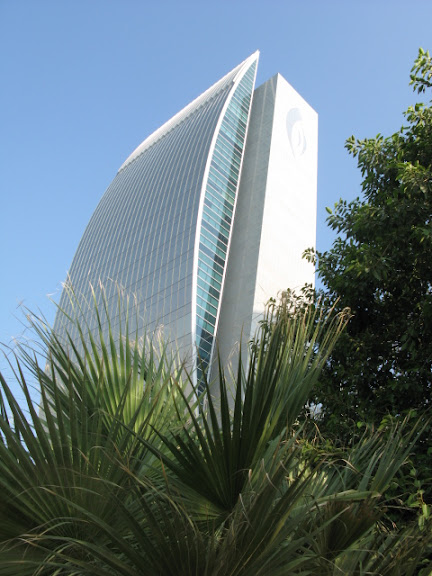 Emirates NBD, the region’s largest banking group in terms of assets promoted its Shari’ah compliant banking products and services at the Jumeirah Beach Residence on The Walk last weekend.
Emirates NBD displayed its extensive range of conventional Shari’ah compliant savings and protection plans which assist customers in reaching their monetary planning goals. The plans offer help with areas such as children’s education, retirement, life & accident protection, long term capital appreciation and general savings. There were some exciting prizes also on offer for interested parties including Magrudy’s vouchers and various dinner vouchers.Emirates NBD’s Takaful and Savings Programme is a Shari’ah compliant, regular savings plan that helps customers increase their savings over a certain duration with Takaful protection for a secure future. Takaful is an Islamic insurance concept based on the principles of the Islamic banking transactions mutual assistance and voluntary contribution. This product consists of choices between monthly, quarterly, half yearly, yearly and low regular contributions.There is also an option of professionally managed Shari’ah compliant investment strategies. In addition this programme offers online underwriting approvals. The Super Saver is a savings scheme with choices on professionally managed funds. It consists of low regular contributions, lump sum options and monthly, quarterly, half yearly and yearly contributions.Mr. Suvo Sarkar, Vice President and General Manager Retail Banking at Emirates NBD said, “We are always devising innovative ways to be near our customers. It is essential to take our services to them and provide them with the details of our many products and banking alternatives. Today’s customer is always on the go, therefore we adapt to better suit their needs by becoming more mobile and utilizing effective channels to create more awareness about the products and services that are available for customers to take advantage of. Our initiatives are always centered around the customer and what is most convenient for them.”This booth at The Walk provided an easy way for customers to learn more about these programmes. The convenient location allowed Emirates NBD to reach out to customers and offer them comprehensive information on the bank’s many Shari’ah compliant banking methods.
--arabianbusiness.com
Friday, June 5, 2009
DFM makes gains to break 2,000 barrier
 Dubai Financial Market broke through the "psychologically important" 2,000-point barrier yesterday, sustaining a bull-run for the eighth consecutive session.
In what experts termed a great relief for anxious investors and financial institutions, the DFM general index closed at 2,025.55 points and showed a net gain of 1.82 per cent, or 36.17 points, compared to its previous close of 1,989.39 points.
"The DFM index broke the important psychological mark of 2,000 points yesterday. Going by the encouraging and positive trading, a 2,200-level is possible soon. We will see some profit taking also," said Sherif Abdul Khalek, trading manager at Beltone Financial Institution.
The DFM general index opened lower at 1,960.56 points and immediately eased to 1,955.91 points before rising towards the key 2,000 mark at 11am.
The buying support in Deyaar, DSI, Arabtec, DIB, Gulf Navigation, Mazaya, Takaful-Emarat, Dar Takaful and Emaar stocks took the index to its higher levels. The closing level of 2,025.55 remained the day's highest and this indicates the positive buying support throughout the session.
Trading value remained on the higher side, with a turnover of Dh1.7 billion and more than 1,235 billion shares traded in 16,696 transactions. The main volume pushers were Emaar, DFM, Deyaar, DSI and Arabtec.The list of losers includes Ekttitab, Shuaa, Al Salaam-Sudan and ACICO.
In the capital, the Abu Dhabi Securities Exchange, after witnessing significant gains on Wednesday, closed flat yesterday on the back of profit taking. Showing a mixed trend, the ADX index eased 6.90 points, or 0.25 per cent, at 2,803.16 points. The turnover was recorded at Dh711m with 417 million shares changing hands in 6,086 transactions. Sixteen stocks closed higher with an equal number moving down, while eight scrips remained unchanged in value. The shares of Aldar, Sorouh, Dana Gas, Abu Dhabi National Energy Company (Taqa), RAK Bank, Emirates Driving and Asmak fell.
--Business24-7
New avenue to issue bonds
 Securitisation of takaful premiums is possible but subject to thorough study
With the corporate bond market in a moribund state, another avenue for bond issuance is via the securitisation of takaful premiums.
According to Syarikat Takaful Malaysia Bhd (STMB) chief investment officer Azian Kassim, the idea is possible but it should be subjected to a thorough study “as the underlying principles of takaful business is totally different (from) that of conventional.”
Maybank Investment Bank Bhd fixed income research head Tan Chee Wee noted that car financing had already been securitised.
“It is the same as the securitisation of car financing – those borrowers are making the monthly payments that are in turn channelled into payment of interest rates on the bonds issued against these auto loans,’’ he said.
In this case, it would be the takaful policyholders who would be providing the cashflow.
“I would say it works, but the important thing is from an investor’s point of view to not just look at the structure but also understand the background of those who bought takaful insurance,” Tan said. “At the end of the day, it boils down to the individual credit of all the people who have taken (takaful) insurance and who are paying the premium on a yearly basis.”
At present, an example of an auto finance-backed corporate bond is the secured fixed rate bond issued by Cepat Assets Bhd.
Securitisation, the process of pooling and repackaging cashflow-producing financial assets into bonds, will provide an opportunity for takaful operators to unlock the value of the underwriting business by transferring certain portions of risks to capital markets.
Azian said the move would require “concerted efforts from various parties for this to happen and among other things, the regulator and syariah board need to be involved.”
“As no such product has been made available in the Malaysian market, the regulatory requirements are yet to be determined. However, given the recent fallout of the collateralised debt obligation (CDO) market in the United States, it is assumed that the regulatory bodies would be very stringent in approving such products,” she added.
For the syariah board, concerns involve the structure for the transaction and also the usage of takaful contributions as the underlying asset.
“At this juncture, there is no plan to securitise takaful contributions. However, we would keep our options open to this new innovative capital market instrument. Should there be any opportunity to embark on such a transaction, the viability of such exercise would be assessed accordingly before any decision is made,” she said.
For the year ended Dec 31, 2008, the total net contribution income for all the takaful operators was RM3.025bil, while total takaful fund assets stood at RM10.569bil.
As to how much this would translate into the potential value of bonds, Azian said: “We do not have any estimates as this is still subject to a detailed study by all respective parties especially capital market players.”
Due to the global financial crisis, there have been calls to move away from complex securitisation schemes since the US subprime collapse is partly blamed on asset-backed securitisation linked to mortgages.
“In our view, the subprime crisis was not a result of complex securitisation schemes but due to a combination of a lack of regulatory supervision and proper assessment by the investors,” she added.
Azian reckoned that the securitisation of takaful contributions would spread the risk more broadly rather than just “warehousing” it in a particular takaful company which has lower capacity and diversification potential than the capital market as a whole.
“The removing of risks from the takaful industry would reduce transaction, agency and regulatory costs, thus increasing the efficiency of capital. Investors would also benefit from the availability of new classes of securities.
“Furthermore, securities based on risks associated with the takaful industry such as catastrophic, mortality and longevity risks are likely to have a relatively low co-variance with market systematic risk, making them even more valuable for diversification purposes,” she said.
However, Azian cautioned that such securitisation must be accompanied with stringent surveillance from the regulatory bodies and proper product education.
--The Star OnlineSaturday, May 23, 2009
Saudi bourse weighed down by profit taking
 The Tadawul All Share Index (Tasi) declined by three per cent last Saturday, dipping below 6,000 points.
 The bourse was weighed down by an eight per cent decrease in the Saudi Basic Industries Corp (Sabic) share price on profit taking after the stock hit 67 riyals, recording a 61 per cent since April 21.
Following these losses, the market bounced back again above 6,000 points, fuelled by the increase in oil prices and the positive performance of the global equity markets.
Meanwhile, bank stocks also declined due to profit taking, especially those of Samba and BJAZ, by between six and seven per cent. In addition, speculation continued on the insurance sector's shares.
The trading values of sectors were as follows: Petrochemical Industries 22 per cent; Insurance 17 per cent; Banks and Financial Services 11 per cent; Industrial Investment eight per cent; Agriculture and Food Industries eight per cent; Building and Construction eight per cent, Telecommunications and Information Technology seven per cent; Real Estate Development six per cent; Multi-Investment four per cent, Retail four per cent; Transport two per cent, Hotels and Tourism two per cent; Media and Publishing one per cent; while Cement, Energy and Utilities remained unchanged.
The top five gainers were: Al Ahli Takaful Co 27.5 per cent; Tihama Advertising and Public Relations Co 25.4 per cent; SABB Takaful Co 25.1 per cent; Saudi Transport and Investment Co 21.6 per cent; and Saudi Industrial Export Co 19.3 per cent.
The top five losers were: Allied Cooperative Insurance Group -22.5 per cent; Samba Financial Group -6.7 per cent; Bank Al Jazira -6.2 per cent; Arabia Insurance Cooperative Co -5.4 per cent; Makkah Construction and Development Co -5.1 per cent. The Tasi registered 6052.63 points on Wednesday, closing up by 0.1 per cent from last week. As of yesterday, the Tasi is 26.0 per cent higher than at the start of the year. Trading value reached 43.3 billion riyals, down against last week's 48.8 billion riyals. Sabic dominated trading value at 13 per cent, followed by Alinma at eight per cent and Zain KSA at four per cent.
--GulfnewsTuesday, January 6, 2009
Year 2008 was a historical year for the Islamic Banking in Pakistan
Islamic Banking grew immensely in Pakistan in spite of the economical crisis.
Lahore: The year 2008 was the best and a landmark year for the Islamic Banking in Pakistan during which the Islamic Banking industry grew far more rapidly as compared to the previous year. During the year, with an addition of 217 Islamic Banking Branches, the number of branches went from 289 to 506 expanding the network to various cities. At the end of December 2007, Islamic Banking deposits and assets were estimated at Rs. 147 billion Rs. 206 billion respectively, whereas there was a drastic increase of 30% to 40% in the reserves during the year 2008. New Islamic Financial products were introduced during the year. The state Bank of Pakistan also issued guidelines for Agricultural Finance and Islamic Micro Finance which have been the milestones for introducing the Islamic Financial products at the Micro level.
These thoughts were expressed by Mr. Muhammad Zubair Mughal, C.E.O, AlHuda, Centre of Islamic Banking in a seminar on Islamic Banking.
He said that besides 6 complete Islamic Banks in Pakistan, there are 506 Islamic branches of 12 conventional banks operating throughout Pakistan which includes 161 branches of Meezan Bank, 25 of Dubai Islamic Bank, 40 of Emirates Global, 102 of Bank Islami, 5 of Soneri Bank, 4 of Habib Metropolitan Bank, 16 of Bank of Khyber, 18 of Askari Bank, 3 of Royal Bank of Scotland, 4 of Bank-al-Habib, 5 of UBL, 11 of SCB, 40 of Alfalah, 1 of Habib Bank, 30 of Al-Baraka, 21 of Dawud Islamic Bank, MCB 8 and 5 branches of NBP .
He further said that currently there is worldwide global financial crisis which has been a major reason for the bankruptcy of various Banks and Financial institutes but in spite of the fact the Islamic banking system is gaining momentum globally which is evident through the facts & figures for Islamic banking in Pakistan.
Lahore: The year 2008 was the best and a landmark year for the Islamic Banking in Pakistan during which the Islamic Banking industry grew far more rapidly as compared to the previous year. During the year, with an addition of 217 Islamic Banking Branches, the number of branches went from 289 to 506 expanding the network to various cities. At the end of December 2007, Islamic Banking deposits and assets were estimated at Rs. 147 billion Rs. 206 billion respectively, whereas there was a drastic increase of 30% to 40% in the reserves during the year 2008. New Islamic Financial products were introduced during the year. The state Bank of Pakistan also issued guidelines for Agricultural Finance and Islamic Micro Finance which have been the milestones for introducing the Islamic Financial products at the Micro level.
These thoughts were expressed by Mr. Muhammad Zubair Mughal, C.E.O, AlHuda, Centre of Islamic Banking in a seminar on Islamic Banking.
He said that besides 6 complete Islamic Banks in Pakistan, there are 506 Islamic branches of 12 conventional banks operating throughout Pakistan which includes 161 branches of Meezan Bank, 25 of Dubai Islamic Bank, 40 of Emirates Global, 102 of Bank Islami, 5 of Soneri Bank, 4 of Habib Metropolitan Bank, 16 of Bank of Khyber, 18 of Askari Bank, 3 of Royal Bank of Scotland, 4 of Bank-al-Habib, 5 of UBL, 11 of SCB, 40 of Alfalah, 1 of Habib Bank, 30 of Al-Baraka, 21 of Dawud Islamic Bank, MCB 8 and 5 branches of NBP .
He further said that currently there is worldwide global financial crisis which has been a major reason for the bankruptcy of various Banks and Financial institutes but in spite of the fact the Islamic banking system is gaining momentum globally which is evident through the facts & figures for Islamic banking in Pakistan.
Subscribe to:
Posts (Atom)