Showing posts with label AlHuda Trainings. Show all posts
Friday, June 27, 2014
Al Huda CIBE extending its services to the USA market
Al Huda CIBE extending its
services to the USA market
Islamic Banking & Finance has a Bright Future in the United
States: Zubair Mughal
(Lahore) AlHuda
Center of Islamic Banking and Economics (CIBE), continuing its commitment to
bring Islamic finance to the United States, announces a joint-training workshop
in Islamic Banking and Finance in conjunction with FAAIF and the University of
New Orleans on October 06 and 07, 2014 in New Orleans, Louisiana, USA. Al
Huda CIBE, having conducted hundreds of successful training workshops all over
the world is excited to enter the American markets to bring fascinating and
complex Islamic finance and banking products and structures to the citizens of
the United States.
Muh. Zubair
Mughal, Chief Executive Officer of AlHuda CIBE, said that Islamic Banking and
Finance has immense potential in the USA market and it has come up with a
blooming prominence after the emergence of International financial crisis,
thereafter Islamic financial system has appeared as a sustainable and reliable
financial system in the world which does not have such flaws which were the
root causes of International financial crisis. He mentioned that about more
than 30 Islamic financial institutions are operating in the USA but the
potential is much higher as USA is suppose to be regional hub for North
America, South America, Latin America and Caribbean countries, a handsome
demand of Islamic financial products already exist in Brazil, Argentina, Canada
and others countries. American continent is dwelling 8 million approx Muslim
population, amongst them Canada have 2% Muslim Population, 0.8% of the U.S. population,
Muslims constitute about 1 percent of the North American population and Argentina has the
largest Muslim population in Latin America with up to 2% of the population,
which shows a big appetite of Islamic financial products in the region.
He mentioned
that we have chalked out a detailed strategy to penetrate into the region with our
services and this workshop is our entry point to introduce Islamic financial
services in this region. He also mentioned that the collaboration of University
of New Orleans and FAAIF for upcoming workshop will further strengthen our vision
to achieve our optimum goal for the development of Islamic finance Industry.
FAAIF CEO
Camille Paldi is looking forward to this tremendous opportunity to bring
Islamic finance to the people of the United States, which is her home country,
and she is very much hopeful that the American people are just as excited as
she is about learning this distinct form of Holy Book finance. Not only
does Paldi hope to enrich the lives of US citizens, she aims to help US
companies stay competitive in the International financial markets and keep
America strong #
Friday, August 31, 2012
Yemen will Host an International Workshop on Islamic Microfinance
Islamic Microfinance is getting appreciation by
the whole world for alleviation of poverty and Muslim and non-Muslim Countries
are utilizing it. Microfinance Institutions in Arab Countries are also
providing Microfinance to Muslims which is in accordance with Islamic standards
in order to get poor out of obscurity of poverty. Amongst these Arab Countries,
Yemen is at the top of the list with other countries like Iraq, Syria, Jordan
and Egypt.
Due to the escalating popularity of Islamic
Microfinance in Arab countries with the intention to increase the reach of Microfinance
Institutions, AlHuda Centre of Islamic Banking and Finance and Yemen
Microfinance Network is going to arrange 2 days training workshop on Islamic
Microfinance on 16th & 17th September, 2012 to be
held in the Capital City of Yemen - Sana’a, in which different topics like the
proper utilization of Islamic Microfinance for alleviation of poverty in poor
countries, Islamic Microfinance Products and their structure, Shari’ah
principles of Microfinance and MicroTakaful would be discussed.
The Chairman of Yemen Microfinance Network,
Mr. Mohammed Al Lai has declared the arrangement of this two days international
workshop on Islamic Microfinance, a good step for the Microfinance sector. He
said that Islamic Microfinance is rapidly growing in Yemen and the workshop
like this will provide more awareness about it.
Chief Executive Officer of AlHuda Centre of
Islamic Banking and Economics, Mr. Muhammad Zubair Mughal has said that AlHuda
has established a separate department for the promotion of Islamic
Microfinance, named as “Centre of Excellence in Islamic Microfinance” so that awareness,
consultancy and training could be provided to the Microfinance Institutions and
in this regard, during this year, workshops will be arranged in Yemen,
Azerbaijan, Nigeria, Kazakhstan, Indonesia and Niger. He further said that the
purpose of this training in Yemen is to make Arab countries aware of the
importance and benefits of Islamic Microfinance which is in accordance with the
religious beliefs of Arab Countries because in Arab Countries, people avoid
conventional microfinance due to the factor of interest and remain stuck in
poverty. So, Islamic Microfinance is very much needed to alleviate poverty in
Arab countries. It should be noted that in spite of abundant oil and natural
resources in Arab regions, some Arab countries are having poverty in them like 23%
people in Iraq, 18% in Iran, 34.8% in Yemen, 13.3% in Jordan, 12.5% in UAE, 28%
in Lebanon and 11.9% in Syria are living under the poverty line.
Wednesday, July 11, 2012
| 50 Thousand Islamic Financial Professional Needed Globally |
| HR Crisis May arise if Demand and Supply Remain Unbalanced |
![]() |
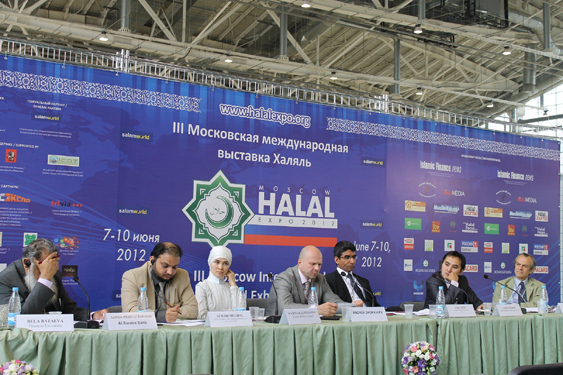
| Zubair Mughal, CEO, AlHuda Centre of Islamic Banking and Economics speaking about Islamic Banking and Finance at Moscow Halal Expo at All Russian Exhibition Centre - Moscow, Russia |
| (Moscow) - In accordance with the growing industry of Islamic Banking and Finance, the whole
world needs 50,000 Islamic Finance Experts right away so that the emerging market of Islamic
Banking and Finance may be easily promoted. These thoughts were expressed by Mr. Muhammad
Zubair Mughal, Chief Executive Officer – AlHuda Centre of Islamic Banking and Finance, during his
speech on the topic of “Importance of Islamic Finance Education” in “Moscow Halal Expo” held in
All Russian Exhibition Centre - Moscow; the capital city of Russia. He said that due to the recent
International Financial Crises in conventional banking and finance, the world is moving rapidly
towards alternative system of banking and finance and undoubtedly, the Islamic banking and
finance system is the first and the foremost choice in this regard because the during financial crisis
had very fewer impact on Islamic finance industry which is the assurance of its future success.
He said that education of Islamic banking and finance is immediately needed internationally. At this time, 38 universities in the world are producing approximately 5000 graduates of Islamic banking and finance per annum, whereas relatively its demand is 10 times more around the globe. If this demand and supply would not be balanced in short time then Islamic banking and finance industry may face many obstacles in its growth and promotion. In the recent era, conventional bankers are being provided with trainings having some of the essentials of Islamic banking and finance in order to adjust them in Islamic financial industry which is a wrong approach and is creating many reservations in financial industry. He further said that in order to establish Islamic banking and finance system on strong foundations, it is needed to produce graduates with complete knowledge of Islamic banking and finance having full command on Shari’ah, Fiqah and Islamic financial products. In this regard, AlHuda Centre of Islamic Banking and Economics has introduced its MBA and Post Graduate Diploma on Islamic banking and finance based on the mode of Distance learning so that the people of countries which currently do not have any facilities of Islamic banking and finance could get advantage of this facility from their office or home and strengthen the rapidly emerging market of Islamic banking. He said that 4 pronged approaches should be adopted in order to educate masses in the field of Islamic banking and finance. 1) Graduation, Masters and Post Graduate Diploma programs on Islamic banking and finance should be arranged at University or College level in order to produce incumbents who could fulfill the responsibilities in Islamic financial institutions at managerial level in an excellent manner. 2) At post graduate level, one year diploma and six months certificate courses on different topics like Islamic banking, Sukuk (Islamic Bond), Takaful (Islamic Insurance), Islamic Fund and Islamic Microfinance should be arranged so that the experts in these fields could be produced. 3) Online programs on Islamic banking and finance should be promoted so that the awareness of Islamic banking and finance may be promoted worldwide as only 20 countries are providing education in this field. 4) Workshops, trainings and publications in the field of Islamic banking and finance should be promoted in order to encourage awareness among masses regarding this. |
Thursday, December 9, 2010
Top Islamic Finance Scholars Oppose Reform

Two of the Gulf's top Islamic finance scholars spoke out against efforts to reduce the number of boards they and their peers are allowed to sit on, challenging industry attempts to improve corporate governance.
Bankers in the emerging $1 trillion Islamic finance industry say the concentration of hundreds of board positions in the hands of a few sharia scholars leads to conflicts of interest and hampers appropriate supervision.
Bahrain based industry body AAOIFI is drafting rules to regulate scholars' shareholdings and the number of Shariah supervisory boards a single scholar can sit on. "There is no need to limit the number of boards," Sheikh Nizam Yaquby, one of the most revered Islamic finance scholars in the Gulf Arab region, told a conference in Manama. He sits on several dozen sharia supervisory boards.
He said there was no similar criticism of other groups such as lawyers or accounting firms working for several banks: "Why should (sharia scholars) not be treated like other professionals in the field?"
Only the Malaysian central bank limits the number of boards scholars can sit on, while the United Arab Emirates this year introduced caps in the insurance sector.A second top scholar in the Gulf, Mohamed Al Qari, also dismissed efforts to limit the number of board seats that scholars are able to hold.
"I don't think it will be very helpful if we restrict the membership of sharia boards to only one, if the member himself is not qualified," he told the conference.He said that simply graduating from an academic sharia program alone was not sufficient to be qualified to sit on a bank's sharia supervisory board and that junior scholars needed to learn from senior colleagues until formal training programs are established.
He said: "This knowledge that has been accumulated by a small number of people can go from the first to
the second generation through apprenticeship."
Both Yaquby and Al Qari are members of the AAOIFI sharia board that develops accounting and auditing standards for Islamic banks.
Bankers say reforms launched by AAOIFI will likely fall short of expectations as scholars governing themselves are unlikely to cut into their own source of income, unless central banks force them to do so.
"This has to come from a body that can regulate, that can impose the rules," Muddassir Siddiqui, an Islamic finance scholar and partner at law firm SNR Denton.
He said that the industry needed to strike the right balance between improving transparency and ensuring scholars develop the know how needed in Shariah supervision.
Tuesday, June 9, 2009
71 percent participants appreciate Islamic banking: survey
In the first national survey on Islamic banking and Takaful, conducted in 85 cities of Pakistan, 71 percent of the participants appreciated it. A spokesperson of AlHuda Centre of Islamic Banking and Economics (CIBE ),on Monday, revealed that they conducted the first national survey on Islamic banking and Takaful to analyse the trends, problems, opportunities and challenges of Islamic banking and the Takaful Industry.The survey was started on April 15 and closed on May 15, covering 85 cities, including Peshawar, Quetta, Islamabad, Karachi, Lahore, Azad Kashmir and many other small cities of Pakistan. The target audience of the survey was the Chamber of Commerce, Business and Trade associations, Universities and professional institutions like the ICMAP, ICAP, etc. This is the first-ever survey in Pakistan for preparing effective strategies concerning trends about Islamic banking and Takaful.
In this survey, 71 percent of the participants appreciated Islamic banking and Takaful. 13 percent, thought it to be the same as conventional banking and insurance, while 16 percent did not give an opinion from ignorance about Islamic banking. 41 percent admitted that Islamic banking services are available in their region, while 59 percent denied that Islamic financial institutions existed in their regions.
It was also revealed that only 11 percent availed the benefits of Islamic banking benefits, while 89 percent had their account in conventional banks. When conventional account holders were asked, they replied that they 'would favour Islamic banking if they were offered the same facilities,' 63 percent said 'yes' and 31 percent said 'no', while six percent remained neutral.
When Islamic banks account holders were asked about the products for financing, 38 percent named Ijarah, 34 percent Diminishing Musharkah and Murabah, while the rest mentioned other products.
--Business Recorder
Wednesday, April 1, 2009
Muslim world urged to promote Islamic banking
RAWALPINDI: The Muslim countries should promote Islamic banking, as its basic aim was not to make money at the cost of people but to play an effective role in eliminating interest.This was said by speakers in a seminar on “Islamic banking and Takaful” held at Fatima Jinnah Women University here on Tuesday.
Al-Huda Center of Islamic Banking and Economics organized the seminar in collaboration with Pak-Kuwait Takaful Company.
Abdul Wadood Khan, a senior scholar, was guest speaker on the occasion.
Khan highlighted various aspects of conventional banking in the light of Islamic teachings.
“Loan is an indispensable need of mankind. Trade, industry, governments and welfare organizations very frequently and rich persons occasionally need loans, but the loan lending should be free of interest. Islam prohibits interest and highly recommends interest-free loan,” he said.
Pak Kuwait Takaful Company representative Adnan Akhtar briefed the participants about Takaful, an Islamic way of insurance.
He said Takaful was based on mutual contribution to furthering good by helping others in need.
He said Pak-Kuwait Takaful was the first Islamic insurance company in Pakistan that believed in promoting the cause of Takaful as well as of insurance business all over the country.
Islamic Relief Fund representative Shazia Hassan also spoke on the occasion and highlighted the concept of Islamic banking.
The seminar was followed by a question-answer session. In the end, certificates were also awarded to the speakers and organizers of the seminar. Staff Report
--Daily Times
Friday, February 13, 2009
Takaful
( by : Zubair Mughal )
Takaful is an Islamic alternative to the conventional Insurance. The words ‘Takaful’ has been derived from the Arabic verb ‘Kafala’ which is also referred to as ‘Kafalat’ in urdu language, its means to guarantee, to help, to take care of one another’s needs. The Takaful system has been structured keeping in view the Islamic system of Dait (Blood Money) which is the philosophy behind mutual assistance/Kafalat. Before going into further details about Takaful, we shall have a look at the conventional insurance system and the factors that led to it being considered Haram or illegal in the society. If the importance of insurance is observed in detailed, the following aspects emerge;
1-To bear the risk/threat
2-To protect others
3-To share the loss
Keeping in view the basic elements of insurance, it is evident that nowhere in Islam the above mentioned aspects are prohibited and that there is no reason to be considered haram or illegal since Islam itself encourages to help others. Narrated by Hazrat Abu Huraira (R.A.) that the Prophet Muhammad (PBUH) said: “Whosoever removes a worldly hardship from a believer, Allah will remove from him one of the hardships on the Day of Judgment.”(Sahih Muslim, Hadith. 59)
Islam teaches us not only to have total dependence on Allah but also emphasizes on self protection against risks and threats. Narrates by Hazrat Anas Bin Malik (R.A.), one day Prophet Muhammad (PBUH) noticed a Bedouin leaving his camel without tying it. He (PBUH) asked the Bedouin, “Why don’t you tie down your camel?” The Bedouin answered, “I put my trust in Allah.” The Prophet (PBUH) then said, “Tie your camel first, and then put your trust in Allah.” (Sunan At-Tirmidhi,.1981). Islam infact even goes to the length of ensuring that incase of one’s death, there should be enough to support the widow for at least a year. Therefore, it is decided that the philosophy of Insurance does not contain any flaws from the Shariah perspective and it can not be considered Haram or illegal. Research has shown that the fault lies not in the philosophy itself, but in the methodology carried out by the insurance companies due to which it is looked upon narrow mindedly.
1-Riba (Interest/Usury)
2-Gharrar (uncertainty)
3-Maysir
Conventional insurance contains both direct and indirect forms of Riba. The direct Riba is in the of Premium and indirect Riba in the shape of interest earned on interest based
Investments e.g. by giving loans to financial institutes and banks on interest or by investing in interest based activity at stock exchange etc. thus promoting interest.
Second factor is Gharrar, where the person being insured does not know when he would bear the loss and to what amount, or the insurer can ascertain the amount and time with respect to profitability. Third element is Maysir, which involves a chance of total loss to one party in the contract, where profit to one person is directly related to another person’s loss. While the relationship of claim between the insurance company and its client is related to each others profit and loss. Thus, by removing these three harmful elements of Riba, Gharrar and Maysir from the conventional insurance, we can call it ‘Takaful’. Now, we shall examine how these elements have been removed in the Takaful system.
The first ever Takaful Company in the world was established 27 years ago in Sudan in 1979 by the name of Sudan Islamic Insurance. It would be interesting to know that the founder of the company was a Pakistani. Following suite, in the same year another company by the name of Islamic Arab Insurance company (IAIC) was formed in United Arab Emirates but it took sometime for the company to establish.
There are approximately more than 155 Takaful and 8 Re-Takaful companies operating globally with an approximate sum of $ 3 Billions Takaful contribution. Out of these companies 60% are General Insurance Companies while the remaining 40% are working as Life and Family Insurance Companies. Geographically, 46% of them are located in South East Asia, 32% in Middle East, 17% in Africa and 5% in Europe and America. For the 23% of the Muslim population of the world, the existence of 260 Billion US dollars worth of Islamic Financial Market is a very encouraging factor for the Takaful Companies.
The systems used by Takaful companies in the world can be divided into three models;
1) Mudarba Model (Sudan, African states)
2) Wakalah Model (Malaysia and other countries)
3) Wakalah Waqf Model (Pakistan)
SECP is the regulatory authority for Takaful companies in Pakistan and has formulated rules and regulations for the companies by making amendments in the Insurance ordinance 2000 while keeping in view the Islamic perspective/principles of Wakalah and Waqf.
Pak Kuwait Takaful was the first Takaful Company in Pakistan and soon after
Another company by the name of Takaful Pakistan came into existence formed by Capt. Jamil Akhtar with the mutual collaboration of House Building Finance Corporation (
HBFC, Emirates Global Islamic Bank, Arif Habib, Sitara Chemical, Emirates Investments Group (U.A.E.) and Al-Buhaira National U.A.E. Pak Qatar Takaful also started their operation in General & Life Takaful Business in Pakistan.
All the Takaful companies operating in Pakistan are based on the Wakalah Waqf model.
The operational methodology/system of the model can be explained through the following example; Some individuals form a Fund on the basis of Waqf and subsequently donate/contribute in the fund, hence giving it the name Participation Takaful Fund ( P.T.F ) with an understanding that if any calamity/risk befalls any of the participants of the fund, a decided amount would be donated (Tabbaru) to the effected. The fund would be monitored by an organization (Takaful Company) on the pattern of Waqf, to safeguard the deposits and to increase the profitability of the fund. Subsequently, the company would be paid its Wakalah agency fee. The example of a Waqf is similar to that of a Mosque Waqf Committee which receives its contributions from people for the maintenance of the Mosque. Likewise, Takaful Company also acts as a Waqf operator. It will receive donations from the people and strengthen the fund. Incase of a calamity to either of the members of the Fund, the company would pay the compensation. Furthermore, it would do its level best to make the Waqf Fund/Takaful contribution more profitable and for that, it would receive its Wakalah fees which would be its profit.
The element of Riba (Interest) is removed from the whole system in such a manner that the Takaful company would invest in interest free institutions to make the fund more profitable while adhering to the rules and regulations of the Shariah and instead of premium, it would receive Tabbaru. As far as Gharrar is concerned, Takaful company is a Waqf and it does not have any direct relationship with the profit and loss of the person insured, instead the Takaful participants would share the risk from their given donations through mutual consent. Thus, the non compliant elements of the Shariah are removed along with the objections on Islamic banking that if Islamic banking defies interest then how come it practices conventional insurance which contains the elements of interest.
Now a new market will emerge in Pakistan, which would support the Islamic Financial system. Those who abstained from Conventional Insurance by calling it un-Islamic, also their savings will increase due to Takaful. With the increase in Takaful funds, the funding resources of Islamic Banks and Islamic Financial institutions will also increase alongside.
since Takaful companies have to invest without interest, their best choice would be the Islamic Banks or Financial institutions or they would opt for Sukuk (Islamic Bond), which would help in promoting the Sukuk market in Pakistan. Actually, the promotion of ‘Takaf’ is related to the expansion of Sukuk market because whenever the issues of
underwriting hedge, Insurance of underlying assets etc. will arise, only Takaful will cover them due to which both will be promoted dually. Thus the Sukuk would be more easily available as compared to the shares to the general public in the market and they would be assets backed. Consequently, the creative evolution of money in the country will come to
a halt because of the asset base which would definitely be helpful in the stability and positive economic growth of the monetary system and short term Sukuk would be the cause of formation of Inter bank market between Islamic Banks and Financial Institutes.
We can compare Takaful with a social organization where the Micro Takaful Ideology should be kept in view and used as a weapon to eliminate poverty in Pakistan.
To eliminate the poverty from the country, while keeping in view the economic, social and geographical conditions of Pakistan, if Zakat, Waqf and the ideology of Micro Takaful are brought forward together, then it would be no less than a revolution.
If Dr. Younas persists that the interest based micro finance system is the only solution for the elimination of poverty, then was the same existent at the time when there was no Zakat receiver. If we try and find solutions to our social and economic problems in the light of the Holy Quran and Sunnah, then there is success both in the world and hereafter.
With the Shariah compliant combination of Micro Takaful, Zakat and Waqf and with both positive and constructive thinking, beneficial results with regards to poverty elimination can be achieved. The question remains, who would think in a positive and broad minded manner when there is no Nobel Prize given on Islamic economics and finance, but only a question.
( The writer is Chief Executive Officer, AlHuda Centre of Islamic Banking & Economics www.alhudacibe.com )
Tuesday, January 6, 2009
Year 2008 was a historical year for the Islamic Banking in Pakistan
Islamic Banking grew immensely in Pakistan in spite of the economical crisis.
Lahore: The year 2008 was the best and a landmark year for the Islamic Banking in Pakistan during which the Islamic Banking industry grew far more rapidly as compared to the previous year. During the year, with an addition of 217 Islamic Banking Branches, the number of branches went from 289 to 506 expanding the network to various cities. At the end of December 2007, Islamic Banking deposits and assets were estimated at Rs. 147 billion Rs. 206 billion respectively, whereas there was a drastic increase of 30% to 40% in the reserves during the year 2008. New Islamic Financial products were introduced during the year. The state Bank of Pakistan also issued guidelines for Agricultural Finance and Islamic Micro Finance which have been the milestones for introducing the Islamic Financial products at the Micro level.
These thoughts were expressed by Mr. Muhammad Zubair Mughal, C.E.O, AlHuda, Centre of Islamic Banking in a seminar on Islamic Banking.
He said that besides 6 complete Islamic Banks in Pakistan, there are 506 Islamic branches of 12 conventional banks operating throughout Pakistan which includes 161 branches of Meezan Bank, 25 of Dubai Islamic Bank, 40 of Emirates Global, 102 of Bank Islami, 5 of Soneri Bank, 4 of Habib Metropolitan Bank, 16 of Bank of Khyber, 18 of Askari Bank, 3 of Royal Bank of Scotland, 4 of Bank-al-Habib, 5 of UBL, 11 of SCB, 40 of Alfalah, 1 of Habib Bank, 30 of Al-Baraka, 21 of Dawud Islamic Bank, MCB 8 and 5 branches of NBP .
He further said that currently there is worldwide global financial crisis which has been a major reason for the bankruptcy of various Banks and Financial institutes but in spite of the fact the Islamic banking system is gaining momentum globally which is evident through the facts & figures for Islamic banking in Pakistan.
Lahore: The year 2008 was the best and a landmark year for the Islamic Banking in Pakistan during which the Islamic Banking industry grew far more rapidly as compared to the previous year. During the year, with an addition of 217 Islamic Banking Branches, the number of branches went from 289 to 506 expanding the network to various cities. At the end of December 2007, Islamic Banking deposits and assets were estimated at Rs. 147 billion Rs. 206 billion respectively, whereas there was a drastic increase of 30% to 40% in the reserves during the year 2008. New Islamic Financial products were introduced during the year. The state Bank of Pakistan also issued guidelines for Agricultural Finance and Islamic Micro Finance which have been the milestones for introducing the Islamic Financial products at the Micro level.
These thoughts were expressed by Mr. Muhammad Zubair Mughal, C.E.O, AlHuda, Centre of Islamic Banking in a seminar on Islamic Banking.
He said that besides 6 complete Islamic Banks in Pakistan, there are 506 Islamic branches of 12 conventional banks operating throughout Pakistan which includes 161 branches of Meezan Bank, 25 of Dubai Islamic Bank, 40 of Emirates Global, 102 of Bank Islami, 5 of Soneri Bank, 4 of Habib Metropolitan Bank, 16 of Bank of Khyber, 18 of Askari Bank, 3 of Royal Bank of Scotland, 4 of Bank-al-Habib, 5 of UBL, 11 of SCB, 40 of Alfalah, 1 of Habib Bank, 30 of Al-Baraka, 21 of Dawud Islamic Bank, MCB 8 and 5 branches of NBP .
He further said that currently there is worldwide global financial crisis which has been a major reason for the bankruptcy of various Banks and Financial institutes but in spite of the fact the Islamic banking system is gaining momentum globally which is evident through the facts & figures for Islamic banking in Pakistan.
Subscribe to:
Posts (Atom)