5 Interactive Distance Learning Programs on Islamic Banking and Finance

Tuesday, January 14, 2014

President of Pakistan to open Observer’s RTC on Islamic Banking tomorrow

   Foreign delegates to share their experience with Pakistani bankers

Tuesday, January 14, 2014 - Karachi—The President, Mr. Mamnoon Hussain, will inaugurate the Round Table Conference on Islamic Banking at the Governor House tomorrow (Wednesday) and the Finance Minister, Senator Muhammad Ishaq Dar, will preside over it. 

In the meantime, The President of the Jeddah-based Islamic Development Bank, Dr. Ahmad Mohamed Ali, has nominated a two-member delegation to represent the IDB at the RTC.

The Governor, State Bank of Pakistan, Mr. Yaseen Anwar, will deliver a keynote address at the RTC where two senior bankers from Malaysia will also express their views on the growing trends of Islamic Banking the world over. It may be mentioned that the Malaysian bankers have played a vital role in promoting the cause of Islamic Banking the world over. Presidents of the top Pakistani Banks will also participate in the RTC and they would have an open house discussion with their Malaysian counterparts.

In addition to the leadership of the Pakistani banking industry, the Chairmen and CEOs of other major entities will also join the RTC along with the President of the FPCCI.

Source: Pak Observer

Friday, January 10, 2014

Islamic banks face a moment of reckoning

Dubai’s push for key role in Islamic economy requires players to raise the game.

Islamic banks face a moment of reckoning

Dubai is preparing to become the capital of the Islamic economy. Experts estimate global Islamic capital amounts to $1 trillion (Dh3.6 trillion), according to a statement by Dr Ajeel Al Nashmi, head of the organising committee for the Islamic Jurisprudence Conference.
Dubai’s objective is in line with its historic endeavours as it set up Dubai Islamic Bank in the 1970s, making it a pioneer in the Arab world in the field of Islamic banking and the second after Malaysia, which experimented with Islamic banking in the 1940s.
Dubai’s goal tasks it with the responsibility of “re-Islamicising” banks in the region or restructuring them to become sound banks. This means Dubai has to focus on preparing a regulatory framework for these banks’ operations, and secondly touching on noticeable weaknesses or shortcomings in Islamic banking services, most notably obsolete ones, and the decline in quality of customer services.
It also has to look into bank advisory bodies, currently undergoing a state of disguised unemployment, bank regulatory bodies, strengthening governance systems, stanch decline in the usage of advanced technology, and intensifying training programmes for technical cadres.
Perhaps a little light should be shed on some aspects of Islamic banking. Often we hear people say that Islamic banks are good, meaning that they offer services that are not provided by conventional banks, despite having come into existence only 40 years ago. Islamic banks portray themselves as “non-conventional banks”.
The word “good” here also suggests that Islamic banks have created new products and non-conventional methods to serve customers, therefore “surpassing” other banks and financial institutions in the Arab world. On the other hand, Islamic banks are not very common in the global market, as most foreign banks are content with setting up Islamic banking solutions to attract Islamic capital.
There are two different services that a customer seeks in banks. The first is when a customer makes a deposit for a period of time for a set profit. The customer has the right to choose the area of investment which they feel is profitable.
The second form of service is when a person opens an account in which their monthly salary is deposited, and in return they receive other services such as a cheque book, credit card, bank statement and other services.
Some banks choose to operate in specialised fields. For example, there are banks that focus on agriculture and others on real estate and industrial projects.
There are two types of non-specialised banks.
The first has massive capital and its operations depend on financing huge projects and providing loans to countries. They have no interest in serving small customers, and they have a limited number of branches.
Banks with a small capital, on the other hand, prioritise customer services, are in regular contact with their customers and always inform them about new products.
Conventional banks operate with interest rates. They invest the money of a customer for profit over a period of time. For example, depositing Dh100,000 in a bank that operates with a 4 per cent interest rate would mean that the customer would make Dh4,000 in profit on their savings.
The perspective of Islamic banks on these is that they are Riba-based, because they set the rate of profit over a predetermined period of time. Therefore, stemming from Sharia, it is prohibited for Muslims to deal with these banks.
Then how do Islamic banks operate? Islamic banks are not any different from conventional banks. They are financial institutions that collect shareholder and customer money, invest them for a profit, which is later distributed to shareholders and customers at the end of each year. These investments are based on ‘murabaha’ against interest.
Murabaha after all is halal (permitted), while interest is riba and prohibited. It is best to quote in this case the Quran, in Surat Al Baqarah (verse 275): “Allah has permitted trade and has forbidden interest”.
Therefore, Islamic banks never set the “interest” for money saved for a certain period, instead the rate of profit is not specified. The reason behind such an approach is that the money of a customer, placed in the bank’s trust, is invested in commercial operation — if the bank makes a profit, so does the customer. If the trade results in a loss, then the customer’s capital remains unchanged.
This means that a customer would get a share of the profit, but their money remains protected against any losses. In face value, this kind of trade feels almost ideal.
This is despite the fact that a loss is liable to occur in any trade as a predetermined factor, but this trading operation is not subject to the profit and loss equation.
On close review, a predetermination might be incompatible with the philosophy behind the referenced Quran verses, as a person committing riba is gambling on the interest rate period for guaranteed profit, while Islamic banks do not specify a time period.
In Islamic banks, for example, if a customer deposits Dh100,000 for a year, they might make a profit of Dh4,000, Dh6,000, or nothing at all. In conventional banks, including non-conventional Islamic banks, the funds deposited by customers and shareholders are invested for profit for investors and customers, and some of this profit will be used by the bank to pay the salaries of its employees, bonuses for members of the board, and operational expenses.
The question is: Where do Islamic banks invest the funds of customers and shareholders? Unfortunately, some Islamic banks invest in areas that are not compliant with Islamic principles that they promote to their customers. Some, for example, invest in local and foreign riba-based banks.
And how do the advisory and regulatory bodies deal with these banks? That is a sad and funny tale best kept for another time.

— The writer is a columnist and journalist.

Source: gulfnews.com

Tuesday, January 7, 2014

Jordan is promoting Islamic Tourism


Jordan has launched a campaign to attract tourists from Muslim countries to boost the domestic tourism sector, reported the al-Hayat newspaper.

“The board launched a campaign to promote Islamic tourism in Jordan and attract tourists from Muslim countries, especially from Malaysia and Indonesia, given that Jordan is a base and a gateway for holy Muslim and Christian shrines,” said Abdul Razaq Arabiyat, the managing director of the Jordan Tourism Board, in a released statement.

The campaign aims to boost the profile of religious sites in Jordan as an attraction for foreign tourists and seeks to promote religious tourism as “a main source of tourism revenues in the kingdom,” added Arabiyat.

A number of promotional programs have been adopted by the board to attract those Muslim tourists intending to travel to Saudi Arabia to perform the annual hajj pilgrimage, who then continue on with their religious tour by traveling to Jordan and Palestine.

“We’ve signed a number of agreements with tourism companies in Indonesia and Malaysia on visiting religious shrines in Jordan and Palestine… such as the site of the battles of Islamic conquests,” said Arabiyat.


Source: CMM-News Blogspot

Monday, January 6, 2014

Islamic Finance On the Verge of a Tipping Point

Will the year 2014 be a tipping point for Islamic finance? It’s a question on the minds of many inside the rapidly growing industry, as a confluence of factors came together in 2013 that could portend a structural shift in how the world views Islamic banking products and the Islamic consumer. In order for the tipping point to be achieved, the industry must move beyond its traditional hubs of Malaysia and the Gulf states and expand across emerging markets, Europe and the United States.
In October 2013, British Prime Minister David Cameron noted that the UK will issue a sukuk, an Islamic bond, making the United Kingdom the first non-Muslim sovereign to do so. He said the UK intends to issue the sukuk in early 2014. Though small in size—the talk was of a 200 million British pound offering—the bond would represent a symbolic breakthrough and pave the way for more substantive offerings.
David Cameron’s government has assembled a team of Islamic finance and industry experts to fashion a strategy for London to compete with Kuala Lumpur, Bahrain and Dubai as an Islamic finance capital. Competition would be good for the industry as a whole, and London’s “stamp of approval” could also serve as a catalyst for growth in other European capitals.
Meanwhile, in the United States, a Washington-based investment bank, Taylor-DeJongh, is leading an effort to package Islamic financing in the form of a security for a major US rail car operator. Continental Rail, a carrier of freight along the east coast, would be among the first major US businesses to receive such financing. That the story was reported in the influential DealBook section of theNew York Times’ business pages should be considered a sign in and of itself. Entitled “Islamic Banks, Stuffed With Cash, Explore Partnerships With the West,” the story ran on the front page of the business section: a wake-up call to all of New York’s investment-banking community.
Taylor-DeJongh has assembled a team of five bankers with experience in Islamic finance who will seek to create innovative products for US companies looking to tap Islamic funds. No doubt others will follow TaylorDeJongh’s lead.
Muslim country sovereign wealth funds and banks based in Muslim countries have long invested in the United States’ equity markets, real estate, and other products, but investors who adhere to Islamic principles of finance are relatively new to the market. The key to the success of Islamic finance in the United States will be its roll-out and messaging. Unfortunately, the term “Islamic” could still be seen as threatening to US consumers. Even those who do not find the idea of “Islamic” finance threatening would view it as exotic and niche.
Thus, a strategy that aligns Islamic finance with the ethical investing movement in the United States would serve the industry well. Second, it should also be presented as a more secure, less risky model of finance. One of America’s most famous economists, Nouriel Roubini, recently said: “There is a need for a more resilient system, and that’s where there is potential for the Islamic system. It is less volatile and potentially more stable than conventional financial systems. The advanced economies can learn from the Islamic system in this respect,” he says.
But perhaps the most consequential factor fueling the tipping point argument might be the aggressive effort by Dubai, announced in 2013, to become the Islamic economy capital of the world. Dubai has a history of spotting a trend in its high growth phase and both riding that trend and reinforcing it. A good example is the rise of Emirates Airline, founded in 1985, and now on track to become the largest carrier in the world and a global brand icon. Emirates Airline both rode the trend of rising mass air travel and also fed the trend by creating more supply.
Dubai was already an important Islamic finance center, but the Emirate sees the story as larger than one of just banking. It has identified seven areas of growth, from halal food to Islamic consumer products to tourism and travel and cosmetics and pharmaceuticals. By growing the pie beyond finance, Dubai has demonstrated the enormous untapped potential of the Islamic economy. Indeed, a report issued by Thomson Reuters estimates the total value of Islamic business at 6.7 trillion dollars. IN GDP terms, this is only surpassed by China and the United States.
Malcolm Gladwell’s famous “tipping point” theory suggested that there is a “Law of the Few,” which posits that a few key types of people must champion an idea before it reaches its tipping point. He calls them “Connectors” and “Salesmen.” Dubai has been playing these roles for the past two decades, even for more than a century, and the emirate’s recent win to host Expo2020 cements its reputation as a global city.
Finally, Dubai’s push is not a passing fad. It is backed at the highest levels of the government. The fact that UAE Prime Minister and Ruler of Dubai Sheikh Mohammed Bin Rashid Al Maktoum appointed his trusted son and heir apparent, Sheikh Hamdan Bin Mohammed, to lead this effort and brought in one of the Arab world’s most capable government advisors, Mohammed Gergawi, to chair the Board, suggests a seriousness of purpose and longevity in implementing the plan.
From rail cars in the US to a British Prime Minister’s promised sukuk to the full weight of Dubai, Inc., pushing forward a strategy of growing Islamic business, the signs of a tipping point abound.

Source
Afshin Molavi

Afshin Molavi

Afshin Molavi is a senior fellow at The New America Foundation, a non-partisan think tank, whose work has been published in dozens of publications, from Foreign Affairs to the New York Timesand the Financial Times.

Saturday, January 4, 2014

International Trade can be enhanced through Halal Certification : Muhammad Zubair Mughal

The Global Halal Market size of 1.8 billion Muslim population is $ 3.2 trillion.
Zubair Mughal (CEO - Halal Research Council) Speaking about “Halal Certification Process” at “International Halal Accreditation Forum 2013” which was held on 25th – 26th October, 2013 at Istanbul by the Govt. of Turkey. This forum was inaugurated and chaired by H.E Tayyip Erdoğan, Prime Minister, Republic of Turkey. — at İstanbul Congress Center / İstanbul Kongre Merkezi
(Istanbul) The importance of Halal Certification is being well-known because of rising awareness with Halal in Muslim societies which is increasing the Halal Certified products and services rapidly and finally international trade can be enhanced in the Halal marker having a size of $ 3.2 trillion of 1.8 billion Muslim population, these views were expressed by Muhammad Zubair Mughal CEO – Halal Research Council (HRC) during the speech at International Halal Accreditation Forum (IHAF) jointly organized by Turk AK, Ministry of European Union Affairs and SMIIC under the supervision of Turkish government on 25th and 26th October, 2013 at Istanbul in which delegates from more than 60 countries participated.

He also said that there are more than 300 Halal Certification bodies working in more than 125 countries while Halal certification is not only the name of business rather a big religious responsibility and on its basis, millions of people use these products discriminating the Halal and haram but a minor ignorance can cause a damage to the Shariah. In Islam Halal and haram is not only confined to the Food industry rather its scope covers the Services (Islamic Banking, Halal Tourism and Halal Business etc), Cosmetics and Physical (Touchable) items. He also pointed out that non-Muslims have 82% control over Halal industry which is the unsafe phenomenon for the Muslims having only 18% share in the Halal industry. He, presenting Pakistan as a Case Study, said that there is viable environment in Pakistan for Halal Industry in which Halal Laboratories, Halal Meat Complex, Halal Accreditation Scheme, Government facilitations and well known Educational Institutes and schools for Food Industry are included that is why the majority people, having more than 50% control on Halal Certification belong to Pakistan and also facilitating in Halal Certification in America, UK, Germany, Australia, Canada, Norway, Switzerland, Belgium and Spain which is an authentic source of availability of Halal Products for Muslims.

Tayyip Erdoğan – Prime Minister of Turkey, addressing to inaugural ceremony of International Halal Accreditation Forum (IHAF), welcomed all the international experts of Halal Industry came from different parts of the world and expressed his well wishes for the success of Forum. Remember, IHAF itself was the first initiative on Halal Accreditation of Halal Certification Industry.     

Friday, January 3, 2014

Certified Islamic Fund Manager

AlHuda CIBE is a pioneer organization started its efforts to promote Islamic Banking & Finance eight years ago. AlHuda CIBE has primarily been committed to provide quality services. It has built up a range of excellent services in the promotion of Islamic Banking & Finance into the masses through Advisory and Consultancy, Education, Trainings, Awareness, Product Development and Publications.

In our continuing development and professional excellence, we are pleased to offer “Certified Islamic Fund Manager” designed by industry specialists and renewed Islamic scholars. This program ensures the balance between the subjective and practical knowledge on Islamic Funds and Asset management. It also offers comprehensive knowledge that will strategically prepare candidates in building their skills, competencies and experience as they enter into the Islamic funds and asset management being Shariah compliant.
Profile of this program is attached for your kind perusal. For further information about the program, please visit: www.alhudacibe.com/dlp/islamicfund.php


Wednesday, January 1, 2014

2014 will be promising for Islamic Finance Industry

Islamic finance volume will be reaching at US $ 2 trillion with having 78% share of Islamic banking, 16% Sukuk, 1% Takaful, 4% Islamic funds and 1% Islamic Microfinance: Zubair Mughal

31-12-2013
(Lahore) Islamic finance will grow with rapid pace in the year 2014 and its volume will pass through US $ 2 trillion where Islamic banking keeps 78%, Sukuk 16%, Takaful 1%, Islamic Funds 4% and Islamic Microfinance has 1% share in the Islamic Finance industry. In the year 2014, Dubai and London will be in competition to be the global hub of Islamic Banking and Finance while Kuala Lumpur will also attempt to be in this contest but the Islamic finance industry can be grown more through synergizing approach and alliance with industry stakeholders rather than setting any competition. These views were expressed by Islamic Finance expert, Mr. Muhammad Zubair Mughal, CEO - AlHuda Centre of Islamic Banking and Economics (CIBE) during an analysis on Islamic finance industry in the beginning of year 2014.        

He said that the Islamic finance industry growth will go on double digit in 2014 which will turn the US $ 1.6 trillion volume of Islamic finance industry in December 2013 to US $ 2 trillion by the end of 2014 including North African countries (Tunisia, Libya, Morocco, Senegal and Mauritania etc), rising trends of Islamic finance in Europe and UK, also the rising and substantial share of international market of Sukuk shall contribute to it. It is anticipated that India and China may step towards the Islamic finance in 2014 where more than 200 million Muslim populations are in search of a compatible financial system with their religious beliefs and thoughts. He said there is no doubt that international financial crisis will not hit the Islamic finance industry but due to the Arab Spring, Islamic finance industry has faced recession in some countries of MENA but there are chances of  their revival in 2014.

He, giving an analysis, said that Sukuk will grow rapidly in 2014 and Muslim countries including non-Muslim countries e.g UK, China, South Africa and Europe etc will also get benefit from it which will enhance the growth in Islamic finance industry but Takaful Industry is not supposed to have any substantial breakthrough. It is being hoped that 2014 will prove better period for Islamic Microfinance industry as different international institutions including Islamic Development Bank (IDB) have declared it a potential tool for poverty alleviation around the globe. He also added that Islamic finance industry may face recession in certain countries including Indonesia while in Nigeria and Tunisia it may face some problems on religious and political grounds. He said that the Islamic finance initiatives in America and Canada including Latin American countries (Brazil, Argentina and others) have been taken and it is hoped that Islamic Funds market will come into existence in these regions by the year 2014.


Tuesday, December 31, 2013

Turkey and World Bank Group Reinforce Cooperation on Improving Islamic Finance and the Country’s Investment Climate

The world bank will open its first center on Islamic Finance

ISTANBUL — World Bank Group President Jim Yong Kim today opened the Global Center for Islamic Finance, together with Turkish Deputy Prime Minister Ali Babacan, as part of a two-day visit to Turkey that focused on enhancing the partnership between the Bank Group and Turkey – the second largest World Bank Group client and a growing key regional player.

The Global Center is envisaged as a knowledge hub for developing Islamic finance globally, conducting research and training, and providing technical assistance and advisory services to World Bank Group client countries interested in developing Islamic financial institutions and markets.

On the occasion of the opening, Kim stated that the Center is a symbol of the Bank Group’s shared objectives of developing Islamic finance and maximizing its contribution to poverty alleviation and shared prosperity in client countries.

“It is my hope that this Center will become the cornerstone for these efforts, serving as a knowledge hub,” emphasized World Bank Group President Jim Yong Kim, “with Turkey taking a leading role in designing and delivering cutting-edge technical assistance, advisory services, as well as generating and disseminating practical knowledge on how to make Islamic finance more relevant for growth and development.”

Earlier in his trip, Kim attended the 5th Izmir Economic Congress, a national economic forum that helps shape the economic policy agenda of the country for the coming years. In his opening remarks, Kim underlined the twin goals of the World Bank Group to end extreme poverty by 2030 and boost shared prosperity for the bottom 40 percent in developing countries.

“Turkey’s economic achievements are an inspiration for many other developing countries,”said Kim.  He added “We look forward to continuing our productive partnership with Turkey to help sustain your impressive achievements, to overcome your remaining challenges, and to share your remarkable experience with countries around the globe.”

Subsequently, Kim took part in a moderated panel discussion on current global economic developments with Deputy Prime Minister Ali Babacan.

In earlier meetings with Turkish President Abdullah Gül, Kim informed the Turkish leader of the new World Bank Group Strategy, how the Bank can share its global experience and knowledge, and the scope for increasing the Bank Group’s financial capacity and, hence, its relevance in middle-income countries. The two leaders also exchanged views on Turkey’s growing regional and global role.

Kim met with Turkish Prime Minister Recep Tayyip Erdoğan. Their discussion covered a range of issues, including Turkey’s broader development agenda, developments in the neighboring region, and how to evolve the Bank’s longstanding partnership with Turkey to cover cooperation and knowledge sharing in other countries. “Turkey has the history, capacity, and accumulated knowledge from experience to play a large and responsible role as a development partner and emerging donor,” stressed Kim.

Prior to concluding his visit to Turkey, President Kim will attend the 8th Investment Advisory Council (IAC) of Turkey at the invitation of Prime Minister Erdoğan.  The IAC is an annual gathering of top national and international private sector representatives to share their views on Turkey's competitive position in the world economy and advise on how to improve the flow of foreign investment. The IAC gathering came two days after the release of the 2014 Doing Business rankings, which saw Turkey marginally improve its position to 69th place among 189 countries.

Turkey joined the World Bank in 1947. Today, the Bank’s portfolio is concentrated and strategically focused, with 11 investment projects and US$4.6 billion net commitments. Over the last decade, the Bank has worked with Turkey on maintaining prudent macroeconomic policies, restructuring the country’s banking system, making public administration more efficient, restructuring the health sector, reforming the energy sector, and supporting disaster risk management.  The International Finance Corporation’s (IFC) strategy in Turkey is to support private sector development. Currently, the outstanding portfolio for IFC’s own account is US$2.4 billion. Fiscal year 2013 was a record year for the IFC in Turkey with US$985 million of investments in 20 projects. Turkey is MIGA’s 8th largest country by gross exposure, representing about 4.2 percent of MIGA’s gross portfolio. MIGA’s portfolio consists of 6 projects with a gross exposure of US$454 million.

About the World Bank Group
The World Bank Group is comprised of five institutions: the World Bank, which is made up of the International Bank for Reconstruction and Development (IBRD), which provides financing, risk management products, and other financial services to middle-income countries; the International Development Association (IDA), which provides interest-free loans and grants to the poorest countries; the International Finance Corporation (IFC), which makes equity investments, and provides loans, guarantees, and advisory services to private-sector business in developing countries; the Bank Group’s political risk insurance agency, the Multilateral Investment Guarantee Agency (MIGA); and the International Centre for Settlement of Investment Disputes (ICSID), which provides international facilities for conciliation and arbitration of investment disputes.


Source: World Bank


Monday, December 30, 2013

Islamic Microfinance Model to help alleviate poverty

(ISLAMABAD) Speakers at a seminar here called for following interest free Islamic microfinance model in order to eliminate poverty from the country.  The seminar was organized on Monday by Al-Huda Centre of Islamic Banking & Economics (CIBE) and AKHUWAT. 

The aim of the seminar was to choke out the plan of poverty  alleviation on national and international scale to lessen poverty, social welfare and to tackle other problems pertaining to it. 

Delegates from Malaysia, Yemen, Kazakhstan, Indonesia, Mauritius and other countries participated in the event who spoke on various topics of Islamic microfinance i.e. methodology of poverty reduction, Zakat, Shariah implications, Dard-e-Hasna, Waqf models, latest trends of Islamic microfinance, technological application of poverty alleviation and usage of Islamic microfinance in non muslim societies. 

Speakers said poverty has risen as one of the most crucial problems of the decade hitching fastest development of the countries on national and international level.  
Islam is the only religion that takes the responsibility of poverty alleviation as one of its main obligations. Zakat, Ushar, Waqaf, Fitrana, Qard-e-Hasna, Murabaha, Ijarah, Musharaka etc have the qualities to sustain society from the plague of poverty. 

“This was the major reason of worldwide recognition of Islamic microfinance as a sustainable source of lessening poverty from the society.
It is a pleasurable factor that more than 2 million beneficiaries are taking the edge of Islamic microfinance worldwide”, speakers added. 

Speakers said that internationally, microfinance was considered a  viable prospective to alleviate poverty but its sustainability was related to high interest rates. “Islamic Microfinance Model like Akhuwat interest-free micro-lending is not less than a miracle as it has proven all the existing viewpoints regarding microfinance wrong by providing interest free funding to the poor”, Athar Axeem Khan, an economist said. 
Dr. Amjad Saqib, Executive Director Akhuwat said that so far the organization has provided funding in the shape of Qarz-e-Hasna  worth of Rs. 1.1 billion to 94,000 families. He said that the recovery percentage remained 99.85 per cent.

Sunday, December 29, 2013

A New Venture Established to Strengthen Islamic Finance in France and USA


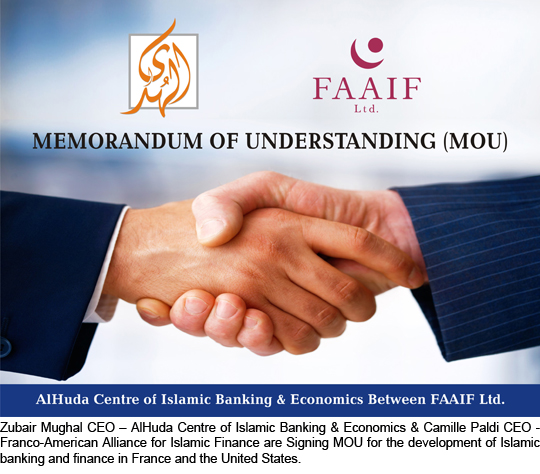
(Dubai - UAE) A Memorandum of Understanding (MOU) has been signed between Al Huda Center of Islamic Banking and Economics (CIBE) and Franco-American Alliance for Islamic Finance (FAAIF) to cooperate in the development of Islamic banking and finance in France and the United States. Both parties agreed to work together, leveraging their different areas of regional and professional expertise of Islamic finance and synergizing their skills for the broader goal of promoting and developing Islamic finance worldwide, especially in the Franco – American region. 

MOU Signing Ceremony held in Dubai, United Arab Emirates today, in which Muhammad Zubair Mughal, Chief Executive Officer of Al Huda CIBE and Camille Paldi, Chief Executive Officer of FAAIF signed the agreement. During the media briefing, Camille Paldi mentioned that she is excited to bring Islamic financial services, training, and expertise to her home country the United States after having spent many years’ education & training abroad in Islamic finance, law, and Shari'ah. With her strong knowledge of Islamic banking, finance, Shari'ah, and law, Paldi hopes to impact the financial services sector in the USA, helping to boost the economy and steer the nation in a new direction. Paldi is excited to utilize her international network to help achieve this purpose, starting with this MOU with AlHuda CIBE. 

While discussing the importance of this MOU, CEO of AlHuda CIBE, Zubair Mughal said that this is the right time to introduce Islamic financial solutions to the Western world so that they may explore the option of solving financial dilemmas and crises with Islamic financial instruments, derived from the Holy Book. Zubair said that AlHuda CIBE will extend their scope of services in European and American markets through the help of FAAIF. He also mentioned that AlHuda's services in these regions would include Islamic finance product Development services, sukuk structuring, Takaful development, and Shari'ah advisory. He also mentioned that Alhuda CIBE already has a very strong professional network in Central Asia, the Middle East, and African regions, but through this MOU, Moghul plans to extend their scope in the American markets as well. 

AlHuda CIBE is a well-established brand in the international Islamic finance and banking industry focusing on Advisory, Consulting, Capacity, and Shariah Advisory services, while FAAIF is an emerging Alliance of Franco – American financial experts, which is headed by renowned legal and Islamic financial expert Camille Paldi.

Saturday, December 28, 2013

Tunisia has big potential for Islamic Finance: Zubair Mughal

Tunisia would be the global hub of Islamic Finance for French speaking countries

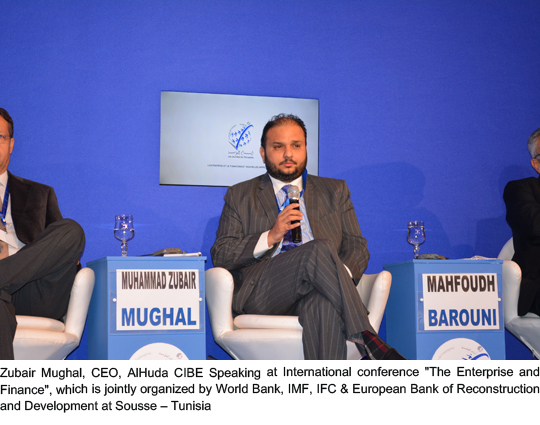
There are big opportunities to promote Islamic finance in Tunisia which can be the global hub of Islamic Finance for French speaking countries, said by Muhammad Zubair Mughal, Chief Executive Officer - AlHuda Centre of Islamic Banking and Economics (CIBE) in an international conference on “Finance and Enterprise” jointly organized by World Bank, International Monetary Fund (IMF), International Finance Corporation (IFC) and European Bank for Reconstruction and Development in Sousse – Tunisia, which was attended by the Prime Minister of Tunisia including many government ministers, heads and senior delegates from Central Banks, World Bank, IMF, IFC, European Bank and other dignitaries from different international organizations.

Muhammad Zubair Mughal, being the guest of honor, during his address stated that international financial crisis can be addressed in a better way through Islamic Finance and such financial crisis could have not been happened if Islamic financial system was followed and implemented at that time, he said there are about 2000 Islamic Financial Institutions working globally as Islamic Banks, Takaful ( Islamic Insurance), Sukuk ( Islamic Bonds), Islamic Fund and Islamic Microfinance institutions etc in more than 100 countries and fortunately no Islamic Financial institution was effected by such global financial crisis which ensures the strength and rationality behind the Islamic financial system. He also added that international institutions such as Islamic Development Bank (IDB), Accounting and Auditing Organization of Islamic Financial Institutions (AAOIFI), Islamic Financial Services Board (IFSB) and International Islamic Liquidity Management (IILM) are dedicatedly working for Islamic finance around the globe which will further promote and strengthen the Islamic finance in future globally. He, responding to a question related to the relationship between religion and Islamic finance in question answer session, said that Islamic banking and finance is a name of a system not religion so all other religions can get benefit from it and that is why Islamic banking and finance is growing in the western world while non Muslims are utilizing the Islamic financial products, considerably, to fulfill their business, personal and financial needs as in only America which has more than 20 Islamic financial institutions are working, which are actively providing the Islamic financial services to fulfill the financial needs of Muslims and non-Muslims equally.

During his stay in Tunisia, he met with Dr. Amel Amri, President – Tunisian Association for Islamic Finance (TAIF), Dr. Raza, President – Islamic Economic Association Tunisia and heads of some other Islamic financial institutions. He said that Tunisia has a good recognition in Islamic financial industry having 2 full-fledged Islamic banks, Takaful companies, universities with having Islamic finance program, Sukuk Laws and some other similar institutions which are indicating the best future of Islamic finance in Tunisia but he, realizing the need of Islamic microfinance, said that Islamic microfinance is missing component of Islamic finance in Tunisia while socioeconomic development and poverty reduction can be done in better way through Islamic microfinance in Tunisia.

Friday, December 27, 2013

Islamic Microfinance should be Introduced Internationally: Dr. Fatima Al-Blooshi

Three days’ 3rd Global Islamic Microfinance Forum ended in Dubai with a declaration to put joint efforts for the poverty alleviation
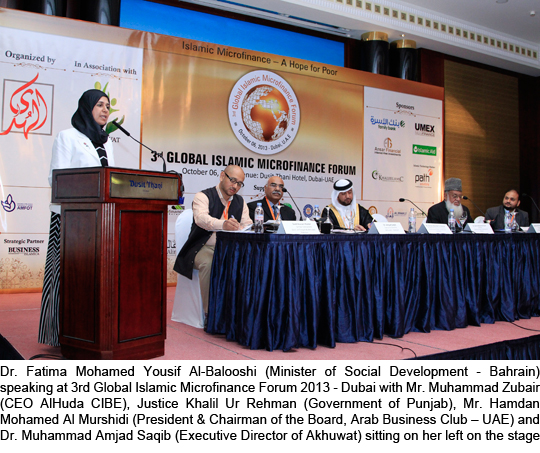
(Dubai) Islamic Microfinance is an effective tool for the poverty alleviation and it should be introduced around the globe to state an effective policy for ultimate poverty alleviation from the world, these views were stated by Dr. Fatima Mohamed Yousif Al-Balooshi, Minister (Ministry of Social Development – Bahrain) as a Chief Guest in the 3rd Global Islamic Microfinance Forum (GIMF) held on 6th to 8th October, 2013 at Dusit Thani Hotel, Dubai in which delegates from more than 30 countries participated actively and this Forum was organized and conducted by AlHuda Centre of Islamic Banking and Economics (CIBE). She also added that Islamic Microfinance should be presided and supported by the Government in different countries of the world to promote the Islamic Microfinance Institutions. She also admired the endeavors of AlHuda CIBE at the inauguration of 3rd Global Islamic Microfinance Forum on 6th Oct, 2013 and also proposed to conduct the 4th Global Islamic Microfinance Forum in Bahrain.

Muhammad Zubair Mughal (CEO – AlHuda CIBE), addressing to the Forum, said that Poverty is increasing in the Muslim countries rapidly and consequently the half of the world poverty has, approximately, been confined to the Muslim countries in the current age. The involvement of interest in micro financing is one of the major causes behind this phenomenon and that is why Muslims hesitate to avail microfinance facility. If Islamic Microfinance is not introduced resolving this issue, the world’s poverty will increase extraordinarily. He said that the forum aimed at gathering all the Islamic Microfinance Institutions at single platform, to streamline the policies for poverty reduction, to promote the Research and Education in Islamic Microfinance industry and to enhance its outreach on global canvas. He said that current facts to the failure of microfinance system require an alternative and prudent Islamic Microfinance system to the world to enhance the financial inclusion globally and ultimate global economic prosperity.

Addressing to the forum Mr. Mr. Hamdan Mohamed Al Murshidi (President & Chairman of the Board, Arab Business Club, United Arab Emirates) said that there is no other argument to address poverty through Islamic Microfinance as it is the ultimate solution to this problem and also he committed with his reward less services to promote Islamic Microfinance globally. While Mr. Amjad Saqib (Executive Director – Akhuwat) said that Islamic Microfinance is a Hope for the Poor which they (poor) are looking forward to resolve their Social and Economic problems, so Islamic Microfinance should be promoted globally. He, by presenting Akhuwat as a case study, figured out that there are about 380000 families benefitting through Qarz e Hasana from Akhuwat. Meanwhile its portfolio has crossed PKR. 5 billion with an increasing trend day by day.

The forum was attended by Researchers, Scholars and Islamic Microfinance practitioners including: Justice (R) Khalil Ur Rehman (Shariah Advisor – AlBaraka Islamic Bank, Chairmen – Punjab Halal Development Agency – Govt. of Pakistan), Mufti Aziz Ur Rehman (Manager-Shariah, Mawarid Finance – Dubai), Dr. Ajaz Ahmed Khan (Microfinance Advisor, CARE International UK), Mr. Atef Ebrahim (Chief Executive Officer, Family Bank - Bahrain), Mr. Zeinoul Abedien Cajee (Founding CEO/ Management Board, National Awqaf Foundation of South Africa), Mr. Mamode Raffick Nabee Mohomed (Founder/ Secretary, Al Barakah Multi-purpose Co-operative Society Limited – Mauritius), Ms. Rehab Lootah (Managing Director - Mawarid Consultancy Dubai - U.A.E), Mr. Mohamed El Mehdi Zidani (Author - An Islamic Analysis of the Grameen Bank and Director Baraka Editions – France), Mr. Pervez Nasim (Chairmen & CEO, Ansar Financial and Development Corporation – Canada), Mr. Abdul Samad (Shariah Advisor, The Bank of Khyber – Pakistan), Mr. Humayun Saeed Jamshed (Senior Director - Islamic Banking & Finance, SAB – France), Mrs. Thamina Anwar (Founder and CEO, Awqaf New Zealand Mrs. Helena Lutege (Founder and Managing Director, BELITA Fund – Tanzania), Mr. Ali Tariq (Executive Director, Iraqi Microfinance Network – Iraq), Dr. Mohammed Kroessin (Global Microfinance Advisor – UK), Mufti Barkatulla (Sharia Advisor, Islamic Bank of Britain, London, UK) and some other prestigious international speakers addressed in this forum.

Islamic REIT is Mandatory for the Development of Real Estate Industry - Muhammad Zubair Mughal

Micro Housing Finance demand can be satisfied through Islamic REIT

(Kuala Lumpur) Islamic REIT (Real Estate Investment Trust) is a beautiful addition to the Islamic Finance Industry with which the Real Estate Industry can be promoted internationally. Mr. Muhammad Zubair Mughal, CEO of AlHuda Centre of Islamic Banking and Economics (CIBE), expressed these views during his speech on the topic of “Islamic REITs” in the Two Days Conference “REITs UNLOCKED” (18th Sep, 2013) held in the Capital of Malaysia (Kuala Lumpur). He told that first Islamic REIT was launched in 1960 in America and now REIT is actively providing the funds to Real Estate Industry in more than 30 countries of the world including Malaysia, Pakistan, Japan, Korea, Canada, UK and Australia for the smooth growth and development of Real Estate Industry while the global volume of Real Estate Industry has reached at US $ 850 billion and also it is worth mentioning that 72% of total global investment in Real Estate is still in America but the amazing fact is the least share of Islamic REIT in the global REIT Industry. First Islamic REIT was initiated by Malaysia in June, 2006 and growing rapidly from last 7 years in its age of infancy. 

He added that Islamic Bonds (Sukuk) were used in the Middle East for the development of Real Estate, although this approach was partially successful but not everlasting because Sukuk has some challenges of current upheavals in the property market of Middle East, although the Real Estate market of Middle East can be managed and settled with the induction and execution of Islamic REITs. Inter alia Islamic Banking and Finance market shall have more financial instruments to ensure the Shariah adherence of their investment portfolio through Islamic REITs, which can potentially be used to manage the liquidity of Islamic Financial Institutions. 

He also told that Islamic REITs can be productively used in underdeveloped countries by addressing the demand of Housing Finance and Real Estate as well to satisfy the ultimate demand of micro housing. The Islamic REIT will not only provide the Shariah compliant products to the corporate industry rather it will turn the dream of more than 100 million homeless people into reality around the globe for getting their homes/houses. He mentioned that Securities and Exchange Commission of Pakistan (SECP) has designed two structures to streamline and grow the REIT Industry and it is expected that, in coming days, the Real Estate Industry will grow through REITs in Pakistan.

"A Big Question Mark on Islamic Finance Industry" by Muhammad Zubair Mughal

Apparently, it is a matter of pleasure that global volume of Islamic Finance Industry has crossed $ 1.3 Trillion approximately, which is, definitely, providing the best and compatible sources of finance with interest free modes. According to a careful estimate, there are more than 2000 Islamic Financial Institutions are offering Islamic Banking, Islamic Insurance (Takaful), Islamic Funds, Mudaraba, Islamic Bonds (Sukuk), Islamic Microfinance and some other institutions actively providing Islamic financial services on different modes in adherence of Shari’ah principles of Islamic Finance. If we look into the market share of above mentioned institutions, we get shocked and depressed for a while with the fact that Islamic Banking and Finance has been nearly confined to the rich people and as per the ideology of capitalism, the profit urge has captured the Islamic Financial Industry and discriminated the underprivileged people and letting them deprived from Islamic financial services. Keeping in view these facts, it should be said as the commercialism has captured Islamic Finance institutions in such a way that business with and financing to the poor has gone astray from their agenda. 

According to the facts and figures (March-2013) by Consultative Group to Assist the Poor (CGAP), (an associated institution to the World Bank), the global volume of Islamic Microfinance has reached at USD 800 million with serving about 1.3 million beneficiaries. While as per the latest research (July-2013) conducted by AlHuda Centre of Excellence in Islamic Microfinance, the global volume of Islamic Microfinance has reached at $ 1 billion. Total number of Islamic Microfinance Institutions is more than 300, operating around the globe while the share of Islamic Microfinance is less than 1% from the overall volume of $ 1.3 trillion of Islamic Finance Industry, which, itself, is a big question mark on Islamic finance industry and proving its misfortune. These stated facts and figures give rise to different question such as: is social segmentation between poor and rich 1% : 99% ? Does Islamic Finance have financial resources only for the rich people? Not for the Poor? Is Islamic Finance an option only for the particular segment of society? Is it justice system of Islam? etc, whereas the answers to all these questions are in negative and awful, definitely. 

As per the analysis of Islamic Finance in the light of Islamic teachings, we get into, the Islamic ideology of finance which aims at justice, cooperation, welfare of the poor and financially deprived people of society with its best principles. Islam is a name of revolution starting from poor and will ending at same. If we have a look at comparative study of different religions regarding the view point of poverty, then we come to know that poverty alleviation is not only the social responsibility in Islam rather a religious obligation as well. Zakat, Charity, Sadqa, Fitr, Usher and Qarz-e-Hasan etc are amongst the key religious responsibilities of Muslims, whereas it is a social responsibility in other religions rather than a religious one which recognized as branded name of “Corporate Social Responsibility” (CSR), and they doing good work for poverty alleviation and social development in the whole world, but unfortunately, Islamic Financial Industry have ignored its social or religious responsibilities. 

If we look at the world poverty, we get surprising facts and figures. The 46% of whole world poverty exists in Muslim World while Muslim population in the world is 26%. United Nations have marked 26 out of 57 member countries of OIC, as the least developed countries. Current statistical information is highlighting that the poverty in the Muslim World is increasing day by day which is, as per the serious observation, caused by none or least response of poor people to Microfinance facilities because of interest, none or limited Islamic Micro Financing facilities provided by Islamic Financial Institutions and the least attention and interest of International Donor Agencies (UNDP, World Bank, IFC) towards Islamic Microfinance which, in return, is throwing the Muslim world into an era of poverty. 

As per the praiseworthy analysis of economics experts of modern age (Mr. Tariq Ullah and Mr. Ubaid Ullah 2008), 650 million Muslims in the world are living below poverty line with less than $ 2/ per day income. While on the other hand, only the 1.3 million Muslims out of 650 million were tried to get them out of poverty through Islamic Microfinance services whereas remaining 649 million Muslim, living in poverty, are still looking forward any financial assistance through Islamic way. Islamic Finance Industry is facing lot of criticism in different aspects e.g. acceptability of Islamic Finance, objections from Shari’ah Scholars, Conflicts in Shari’ah related issues etc are the main challenges to Islamic Finance Industry. But objection to neglect the poor is very critical, once not resolved, can damage and bring a perpetual loss to the Islamic Banking and Finance Industry. 

The optimal results for the economic prosperity of Islamic Finance can be ensured if Islamic Microfinance Institutions established by the Islamic Finance Industry. Although Islamic Microfinance can be energized by utilizing available charity amount of Islamic Banking and Finance industry which is worth in Million Dollars. Inter alia Zakat, Sadqaat, Waqf, other Islamic Microfinance products e.g Murabaha, Musharaka, Salam and Istisna etc can be used prolifically for poverty reduction and social development. 

Our Shari’ah scholars are also responsible for insisting and pursuing the Islamic Financial Institutions to execute and promote Islamic Microfinance otherwise there is a definite chance of rumors that Islamic Banking and Finance services are only for rich people making discrimination of “Do Have and Have Not” and ensuring its ultimate benefits only to rich people. 

( Muhammad Zubair Mughal as a Chief Executive Officer of AlHuda Centre of Islamic Banking and Economics (CIBE) has been working consistently for last nine (9) years for poverty alleviation through Islamic Microfinance concept; he can be reached at zubair.mughal@alhudacibe.com )

Thursday, December 26, 2013

Indonesia’s BMT Microfinance system should be introduced Globally: Zubair Mughal

In Indonesia 5,500 BMT’s are struggling under Islamic Microfinance to eliminate poverty.

(Lahore) Baittul Maal wa Tamwil (BMT) Microfinance system which is being working in Indonesia should be introduced all-around the globe as a best system to eliminate poverty which will boost-up Islamic Microfinance industry worldwide, These thoughts were expressed by Chief Executive Officer of Al-Huda Center of Islamic Banking and Economics Mr. Muhammad Zubair Mughal in his address in an International conference for “ Empowering SMEs for Financial Inclusion and Growth” held at Jakarta – Indonesia, which was organized by a well known financial institution “Sampoerna Group” of Indonesia in which large number of professionals related to Microfinance, SME, Banking and other Financial institutions participated.

During his address Mr. Muhammad Zubair Mughal Said that, Islamic financial industry of Indonesia with having 11 complete Islamic Banks, 24 Islamic windows, 43 Takaful Institutions, 16 Islamic Finance companies and more than 5,500 BMT’s holds a remarkable position in the world. He said, BMT’s in Indonesia has played an important role for the alleviation of poverty from country by adapting methods of Islamic Microfinance system, which is a clear example of success of this system But unfortunately, BMT’s methods are being limited to Indonesia only, but it is the need of the time that this system should be introduced in other countries of world along with Indonesia which will help in introducing Islamic Microfinance system in other countries of world and new Islamic Microfinance methods of BMT will be available along with Murabaha, Salam, Mudarabah, Qarz-e-Hasna and Waqf to Islamic Microfinance Institutes. 

He further added that, to involve poor in financial inclusion Islamic Microfinance is very important along with branchless banking, Product innovation and financial literacy etc Because in Muslim communities major reason of poverty is to avoid interest based Microfinance and in order to bring Muslims in financial inclusion then such a Islamic Microfinance system need to be introduced which will be according to the Muslims religious and economic principles otherwise poverty will increase due to financial excluding of Muslims, which can be estimated from present facts and figures that half of world’s poverty lies in Muslim countries. 

He further added, to gather Islamic Microfinance institutions and professional of the world on single plate form, the Global Islamic Microfinance Forum is going to be held on October 16, 2013 in Dubai, to compile the strategy to strengthen Islamic Microfinance industry.

Saturday, November 30, 2013

Growth of Malaysia's insurance, takaful sectors seen stable

KUALA LUMPUR: The growth of the insurance and takaful sectors for 2014 will remain stable amid domestic demand, said industry experts.
Takaful Malaysia group managing director Datuk Mohamed Hassan Kamil said strong growth prospects and improved risk management would lead to increased demand for insurance and takaful amongst the public at large.
He said the industry is anticipated to remain encouraging for both conventional and takaful operators through the introduction of new or enhanced and innovative products by insurance takaful companies.
“There is plenty of room for organic growth, given the fact that Malaysia still has low insurance penetration in both the conventional and takaful sectors.       
“In addition, we project a muted earnings growth outlook in certain areas of the local insurance and takaful industry arena that is likely to be impacted by investment de-risking and financial market volatility,” he told Bernama.
Regarding market players, he said the local insurance and takaful players are expected to utilise multiple distribution options available and develop alternative channels whilst strengthening their agency force to establish a solid foothold in the industry.
He said this will be supported by the implementation of strategic marketing and operating systems on top of competitive and cutting-edge products and services offered by respective industry players.
Hassan Kamil said despite the positive outlook, the industry will face diverse changes that were expected from the enforcement of the Risk-Based Capital (RBC)framework in 2014.       
“The RBC implementation might change the landscape of the takaful industry and the expected contribution growth is deemed to accelerate modestly, with fairly robust growth amongst takaful operators outpacing the conventional players,” he said.
Apart from that, both industries have been experiencing an influx of mergers and acquisitions (M&As) resulting in more foreign insurers tapping into the Malaysian insurance market, he said.
Amongst M&As this year were Khazanah Nasional Bhd’s partnership with Canadian-based Sun Life Financial Inc to acquire 98% of CIMB Aviva Assurance Bhd for RM1.8bil, and American International Assurance Bhd’s acquisition of ING’s insurance and takaful business in June 2013.
The industry has seen new players from Canada and the US coming into the Malaysian market, taking over the smaller local players.
“We have witnessed the emergence of financial solid players in the local insurance industry arena as a result of the M&A exercises.       
“The insurance and takaful industry in Malaysia remains encouraging for both life and general insurance and takaful despite moderating economic growth following the slowdown in major advanced countries,” Hassan Kamil said.
The persistent talent shortage, of professionals well versed in both principles, would be one of the main areas that need to be looked at critically in order to remain competitive in the industry, he said.
In addition, he said the rapid development of insurance and takaful industry has made it all the more difficult to recruit the right human capital needed for the various job functions. — Bernama

Saturday, November 9, 2013

ASEAN Countries have big potential for Islamic Finance: Zubair Mughal

(Manila - Philippines) There are multiple opportunities in Association of Southeast Asian Nations (ASEAN) countries to promote Islamic Finance, through which Halal Industry can be flourished rapidly in the region. These views were expressed by Muhammad Zubair Mughal, Chief Executive Officer, AlHuda Centre of Islamic Banking and Economics (CIBE) during his speech at “First National Halal Forum” in Manila which was organized by Department of Science and Technology, Government of Philippines at a local hotel (Shangri-La Makati) on 29th- 30th October, 2013, in order to grow Halal Industry and Economy on both regional and international level.


During his address to the Forum, he stated that Islamic Finance and Halal Industry are complement to each other. Micro and Small Medium Enterprises (MSME’s) can be energized by utilizing Islamic Finance concept in the region which will be cause to reduce in poverty and ultimate socio-economic prosperity in the ASEAN member Countries. He, presenting an analysis on ASEAN countries (Malaysia, Indonesia, Brunei Darussalam, Loa PDR, Myanmar, Singapore, Thailand and Vietnam), stated that the approximate total population of ASEAN countries is 600 million including the Muslim Population more than 40% (240 million) which is a potential indicator for Islamic Finance growth whereas in Malaysia, Indonesia and Brunei Darussalam already have significant contributions in Islamic Banking, Takaful, Sukuk and Islamic Funds, while Philippines and Thailand are being considered as future potential markets for Islamic Banking and Finance in ASEAN countries.

He explained that Islamic Banking and Finance is the system not a religion which can be utilized by Muslim and Non-Muslims to get absolute benefits from the best services of Islamic Banking and Finance as its best example is the South Africa where Muslim population is less than 2% of the whole population but it has more than 5 Islamic Banks, 13 Islamic Funds and 2 Takaful companies working actively, which are equally famous among Muslims even non-Muslims communities because of their best practices and services. He said that Philippines is an important country of the region with having 100 million populations, approximately, containing Muslim population by more than 7% which bears it out that there are momentous chances for the promotion of Islamic Finance and, apparently, government of Philippines found active in this concern and it will, definitely, energize Islamic Banking and Takaful in result. He also stated that government of Philippines can generate financial resources for national level mega projects by utilizing the concept of Sukuk (Islamic Bonds).

National Halal Forum continued for two days at Manila where experts from different countries of the world participated including Pakistan, Turkey, Malaysia, Indonesia and Thailand #